Wednesday, November 2, 2016

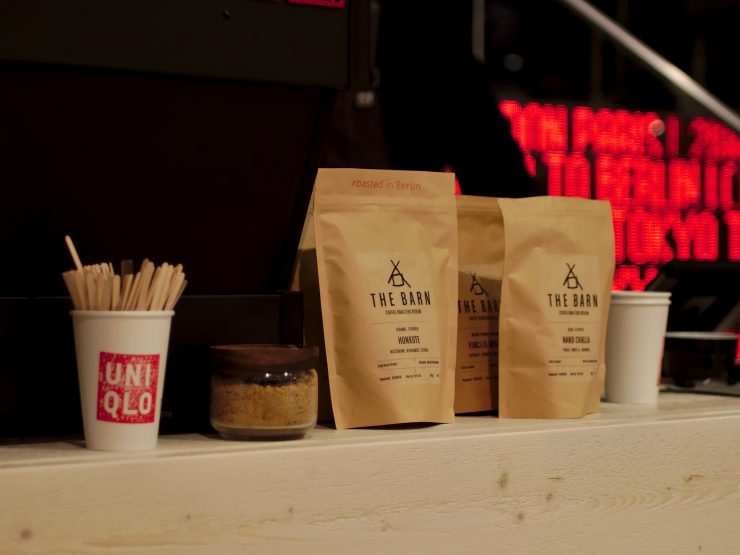
Berlin: The Barn Pops Up A Coffee Bar With Uniqlo

the barn berlin coffee roastery germany uniqlo pop up shop sprudge

I meet Ralf Rüller at The Barn’s roastery, a soaring almost-gallery of a space with an L-shaped brew bar so long you could lap it. All the wood in the room is reclaimed, or at least looks the part, and there are these west-facing windows that light floods through before pooling all over the place. It’s like, quite literally, someone’s transplanted the bones of a barn into the center of East Berlin.

“For a long time, things in East Berlin were still bombed out,” Rüller says. “There was no gastronomy here after reunification, so it offered the most platform for change and for foreigners to move in and to find it interesting.”

the barn berlin coffee roastery germany uniqlo pop up shop sprudge

Ralf Rüller.

Rüller founded The Barn six years ago a few blocks away in a space far more like a shed in size. He still lives in the neighborhood and says he knows everyone who comes into the shop by name. But most of those customers have been and continue to be foreigners—transplants from other places more familiar with coffee like The Barn’s.

“The coffee scene came with very strong international influxes. When I started, there was almost nothing as far as a community was concerned, just a few people starting out. All our reference points for quality and traceability and high-quality coffee were abroad.”

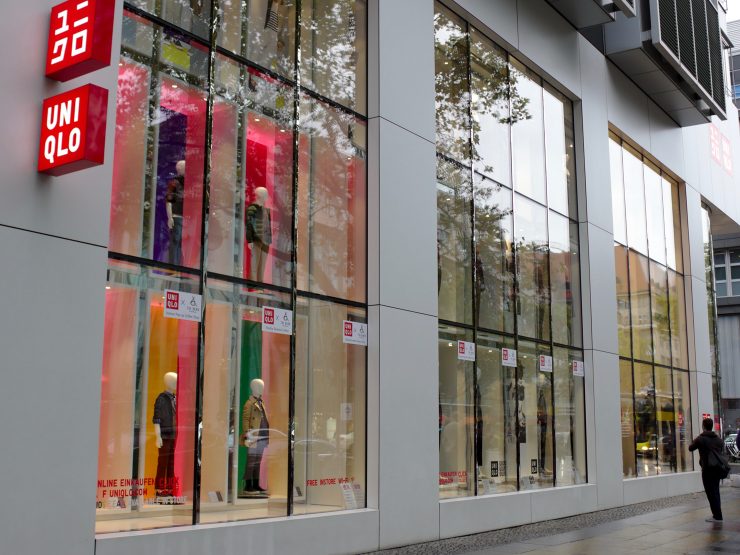
But we’re not here to talk about his company’s past, instead, we’re meeting about its future. Last month Rüller opened a pop-up in the basement of Japanese retailer Uniqlo’s Berlin flagship store.

the barn berlin coffee roastery germany uniqlo pop up shop sprudge

the barn berlin coffee roastery germany uniqlo pop up shop sprudge

“I lived in Japan when I was in my early 20s,” Rüller says. “I still go there every other year to visit friends. So there are a lot of reference points for me from Japan—our bar uses Hario equipment, and we make it a feature in all of our shops to really showcase brewing, slowing down. The Japanese element has always been there in all our philosophy and in everything we do.”

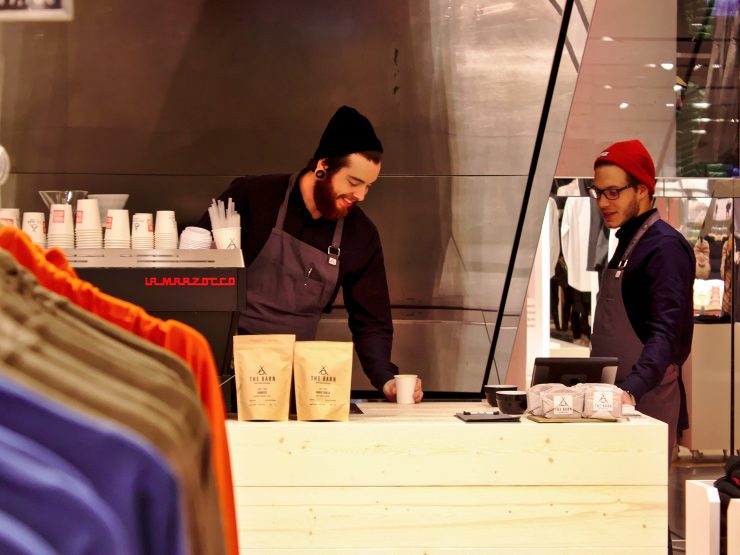
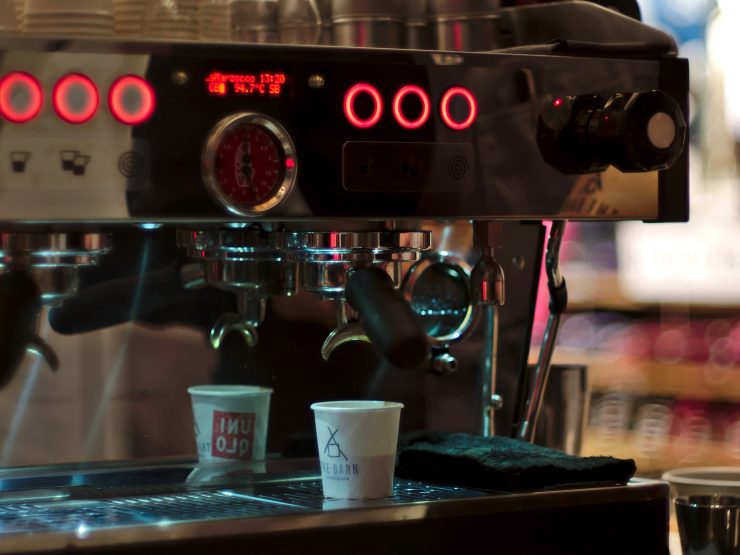
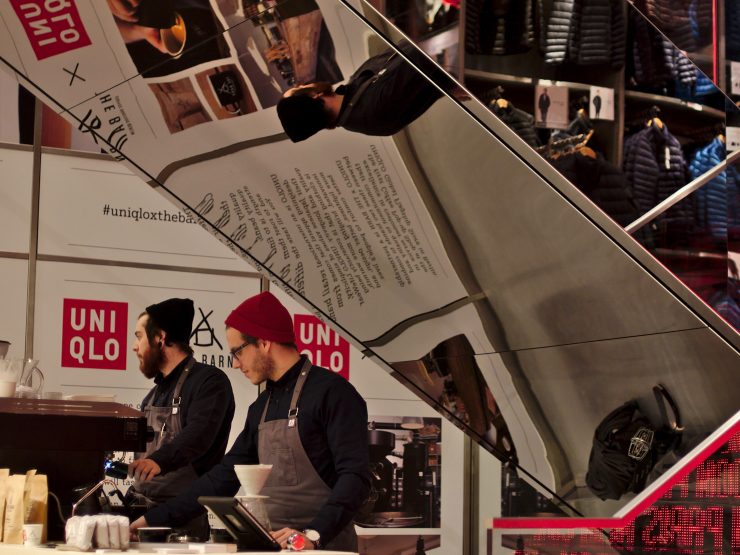
And so, Rüller makes clear, first and foremost The Barn’s new pop-up is a collaboration with a Japanese clothing company. It’s pared down to the nth degree: just an EK 43, a two-group La Morzocco Linea PB, two baristas, and a couple of Chemexes and V60s. But every detail seems streamlined and sharpened and very much deliberately The Barn, with a matte black espresso machine like something swiped from a Star Destroyer.

the barn berlin coffee roastery germany uniqlo pop up shop sprudge

the barn berlin coffee roastery germany uniqlo pop up shop sprudge

But more than being just another Barn, the pop-up represents an evolution for the company. In particular, by moving into West Berlin, which is predominately German in its makeup, Rüller is making a statement.

“I’m German and I feel like I’m on German soil. I want to reach out to more German people. My goal as a German roaster is to have an impact on changing the roast scene and the coffee scene in Germany. I think West Berlin is giving us that.”

As for plans to expand beyond the pop-up, which will be operational at least through the end of December, Rüller doesn’t hesitate.

“We’re looking at spaces all the time.”

the barn berlin coffee roastery germany uniqlo pop up shop sprudge

The Barn at Uniqlo is located at Tauentzienstraße 7b/c, 10789 Berlin. Visit their official website and follow them on Facebook, Twitter, and Instagram.

Michael Light is a writer and editor originally from Ohio. He’s worked previously for Vice and Lucky Peach. Read more Michael Light on Sprudge.

The post Berlin: The Barn Pops Up A Coffee Bar With Uniqlo appeared first on Sprudge.


from RSSMix.com Mix ID 8200593 http://sprudge.com/berlin-barn-pops-coffee-bar-uniqlo-110457.html?utm_source=rss&utm_medium=rss

Better Coffee, Better Lives: Why a Library Benefits Farmers

My sister and I set out to rescue the family coffee farm – but ended up establishing a family countryside library.

Our country, Honduras, is as renowned for its good coffee as it is for its social issues: crime, poverty, and unemployment. In 2014, World Bank put the poverty rate at 62.8%.

Yet we believe a library can help improve the lives of women and children, boost families’ incomes, and help produce better coffee.

SEE ALSO: The Film Asking If Teaching Children to Farm Can Stop Gang Crime

Engineer instructs coffee farmers on organic farming

Education is the key to a thriving community. Credit: Claudia Albir

The Need for a Family-Oriented Solution

My sister, Sabrina, and I knew our family coffee farm was struggling. Once a beautiful place with healthy coffee trees, strong fruit trees, and thriving honey bees, it had become unsustainable.

Nor were we the only family with this problem. The nearby village of Las Manos also struggled with unsustainable coffee farms.

We wanted a better model for the farm and for the village. And so organic farming became our mission. We took on an agricultural engineer specializing in organic farming and invited the community to participate in courses free of charge. It was a great success. Many small producers finished the courses full of excitement.

Yet we weren’t satisfied. We wanted more female participants. And we saw the local children and wondered to provide ways to develop their creativity while furthering their education.

We wanted to integrate social solutions into economic ones.          

coffee production

Credit: Sabrina Albir

The Family Countryside Library: A Solution for All Seasons

Our aims were ambitious. We wanted to help mothers work and give women independence. We wanted activities for kids and families. We wanted organic farming education. We wanted to prompt discussions on important topics: child abuse, parenting, Honduran culture, business management, and more. We wanted Las Manos to become more creative, more organized, and more entrepreneurial.

And we thought a family countryside library was the solution. What’s more, it’s a solution for all seasons.

When mothers need to work on the farm, to harvest the coffee and dry the cherries, the children can stay at the library to be taken care of. And at other times of year, when people do not have to work such long hours on the farm, it is a place for anyone in the community.

We took inspiration from Human Farm/La Finca Humana. We knew that organic agriculture and education can bring communities together.

Book collection bin

We collected books via donation. Credit: Sabrina Albir

Building the Library

We planned for the library to be hosted in the village church and primary school. We had the location – but we still needed the books. Fortunately, the village was behind us and people were willing to donate books.

The collection finished on the 16th of October. Now we are organizing the library, which we plan to open in December or January.

aldea las manos

Coffee farming does not exist in isolation. The beans are grown and harvested, processed and packed, by a community. And when that community has problems, so does the coffee industry. When women cannot work, there are only half as many coffee pickers. When children cannot be cared for, the coffee farmers of the future are being neglected. And when farmers do not know about the latest farming techniques, we can taste it in the cup.

A family countryside library, however, can educate the farmers. It can provide a safe space for children to grow and learn. And it can enable women to work on the farm.

It may be the key to making our farms sustainable.

Written by C. Albir.

Perfect Daily Grind

Want to read more articles like this? Sign up to our newsletter!

The post Better Coffee, Better Lives: Why a Library Benefits Farmers appeared first on Perfect Daily Grind.


from RSSMix.com Mix ID 8200593 http://www.perfectdailygrind.com/2016/11/better-coffee-better-lives-library-benefits-farmers/

Tuesday, November 1, 2016

Introducing CoffeeChamps, SCAA’s New Look Regional Competition

After last year’s debacle of cancelling the regional barista competitions and subsequent impressive turnaround of then putting together a last minute mega-regional, the SCAA Competition Committee announced their plans back in July of having two regional events in 2017 and no less than six micro-regional events in the following years. But details on exactly what that looked like were still a bit fuzzy. Until now, with the SCAA’s official release of the 2017 competition schedule.

As promised, there are two regional events feeding into the US Coffee Championships taking place at the SCAA Expo on April 21-23 in Seattle, WA, the third time in four years the city has hosted the event. Known as “CoffeeChamps”, the competitions aren’t true regionals but are more of a pair of open borders qualifying rounds. According to the announcement, “anyone who resides in the U.S. can compete in either of the CoffeeChamps events, regardless of their region.”

The events are to be held in Knoxville, TN and Austin, TX on January 21-22 and February 11-12, respectively. Unlike previous qualifiers, where only Barista Championship and Brewers Cup competitors had to earn spots in the Nationals, this year competitors in all five disciplines—including Roasters, Cup Tasters, and the resurrected Latte Art—will have to win their way to the big show.

UPDATE: The available slots for this year’s Barista Championship qualifying round have increased to 120 from 100. Similar to last year’s super-regional, Barista competitors will have 10 minutes to complete their routine, but a new twist in 2017 format is that competitors will only be serving two courses: espresso and the signature beverage. The milk beverage course will reappear at Nationals when competitors have the full 15 minutes, which also means we are going to have to wait six more months to hear Lorenzo Perkins say “milkies”.

A total of 36 competitors will advance to the US Barista Championship this year. The top six from each of the CoffeeChamps are awarded byes directly into the semifinals, and the 12 highest scoring baristas from each regional not in the their respective top six earn spots in the first round at Nationals.

A full set of details about the just announced events along with information for those looking to compete can be found on the US Coffee Championships website here.

Zac Cadwalader is the news editor at Sprudge Media Network.

*top image via US Coffee Championships

The post Introducing CoffeeChamps, SCAA’s New Look Regional Competition appeared first on Sprudge.


from RSSMix.com Mix ID 8200593 http://sprudge.com/introducing-coffeechamps-scaas-new-look-regional-competition-111000.html?utm_source=rss&utm_medium=rss

Blanchard’s Coffee In The Little Big City Of Richmond

blanchard's coffee roasting company richmond virginia usa roastery sprudge

Richmond, one of America’s venerable towns, is having a bromance (and womance of course too) with coffee. With a handful of roasters, coffee shops, and neat cafes driving the city’s scene instead of each fending completely for themselves, they all club together to form an elbow-rub of love for the bean. Call it camaraderie, if you will.

One of these roasters, with more than 10 years of expertise in this town, is Blanchard’s Coffee Roasting Company, founded by David Blanchard. With a brand new roasting space that just recently opened, the roastery is doing big things for the city, the state, and the country. As it happens, at Blanchard’s roastery, they simply give coffee away to whoever weighs anchor at the space. “During our regular operating hours, whatever we’re drinking, anyone can come and drink as well—they just have to bring their own cup,” says Stephen T. Robertson, Director of Sales and Marketing, who is also their on-hand copywriter.

blanchard's coffee roasting company richmond virginia usa roastery sprudge

blanchard's coffee roasting company richmond virginia usa roastery sprudge

A decade ago, weary of not getting a solid caffeine fix with all that nuance and beauty, Blanchard sold his wife’s car to buy a small Ambex coffee roaster (which was valiantly set up in the garage) and that is how his notion sallied forth. The initial gist was a “coffee of the month” club for friends and family, but that quickly turned a sharp corner and Blanchard’s transmuted into the specialized regional craft roaster that it is today. “We focus on three major markets: roasting for coffee shops and other brewers looking for a specialty coffee program, roasting for retailers like Whole Foods and Wegmans, to independent markets and smaller regional grocers, and our web store, which now has regular customers in all 50 states,” says Robertson.

And Richmonders are learning all along the way. “You still get to see wonder on a lot of faces in Richmond when you hand them a cup of coffee,” says Seth Bauserman, Director of Operations and the Head Roaster. “The mindset here is still in tradition, and we try to honor that, but we also get to be a part of shifting some of the population towards a new kind of coffee experience, and that is very exciting to be a part of,” he continues. The city, filled with young people and a creative crew at that, is starting to place itself more firmly in the series of alternative East Coast cities in the US comparable to Greenville, Asheville, Beaufort, and even Savannah.

blanchard's coffee roasting company richmond virginia usa roastery sprudge

blanchard's coffee roasting company richmond virginia usa roastery sprudge

One of the ways Blanchard’s is buddying up with its local community is through public coffee courses on Fridays (the rest of the week, the city’s coffee lovers float in to purchase their beans and bring their mugs to sample the latest loot). “The Richmond coffee industry is still in its infancy, and one of our biggest goals has been to make specialty coffee approachable and accessible to everyone,” says John Kruegler, Director of Education and Assistant Roaster—it seems everyone here wears two hats.

But really what attracts coffee fans, from all over the country, is Blanchard’s broad appeal. “You like fruit-forward, bright, juicy coffee? We got you covered! You like the dark, bold, rich cup to wake you up in the morning? A fresh bag of Dark as Dark will do the trick! You need just the right coffee to start your next Toddy brew? I have just the bag for you!” promises Jake Hansen: Distribution Manager, also an Assistant Roaster. “We believe that we speak to coffee novices and aficionados alike.” And if you ask the locals they’ll say just that—no coffee snobs with too many highfalutin spars here.

blanchard's coffee roasting company richmond virginia usa roastery sprudge

For now the crew is focused on roasting, and perfecting that. “Other coffee [companies] roast their own coffee but oftentimes have their own cafes to manage and maintain, but we don’t have that,” says Hansen. “We roast amazing coffee to sell to anybody who wants some, and don’t have to clean up a messy cafe at the end of the day to make ends meet.” After all, if you bring your own cup to taste with, you’re packing it out, too. With the new location, Blanchard’s is now employing a Toper 30-kilogram roaster, Loring Kestrel 35-kilogram roaster, and a San Franciscan one-pound sample roaster.

Blanchard’s is so much about inclusivity—with beans from all over the globe expressing that. “Right now, we are working with Bayardo Reyes in Nicaragua at Finca San Jose to produce some outstanding coffee. We have a few different sectors of his farm and all of the coffee that he sends us is spectacular,” says Hansen. “We also receive coffee from Daniel Velasquez in Colombia who runs Campesino Specialty Coffee and Finca El Ocaso. The other avenue that I love to work with is Ally Coffee. They know our palates better than we know our own and never fail to send us incredible samples.”

David Blanc

David Blanchard and assistant, Mac.

blanchard's coffee roasting company richmond virginia usa roastery sprudge

And this band of insiders, all friends, share everything. Attitude is what makes this generation of coffee enthusiasts so, let’s call it what it is, cool. Hansen agrees: “Our generation of coffee enthusiasts is pushing the industry to a position of transparency. For decades the various processes built into the ladder of ‘seed to cup’ have been hidden and thankfully we are closing the door on the days of discreet sourcing. I see so many roasters and cafes now displaying clearly where their coffees come from and the traceability is spectacular.”

“One of the most beautiful things about coffee is how it has a shared language,” says Bauserman with a smile, “that makes the world smaller.”

Blanchard’s Coffee Roasting Company is located at 1903 A Westwood Avenue, Richmond, Virginia. Visit their official website and follow them on Facebook, Twitter, and Instagram.

Daniel Scheffler is a Sprudge staff writer at large. His work has appeared in T Magazine, Travel And Leisure, Monocle, Playboy, New York Magazine, The New York Times, and Butt. Read more Daniel Scheffler on Sprudge.

All photos courtesy of Cameron Lewis. 

The post Blanchard’s Coffee In The Little Big City Of Richmond appeared first on Sprudge.


from RSSMix.com Mix ID 8200593 http://sprudge.com/blanchards-coffee-little-big-city-richmond-106698.html?utm_source=rss&utm_medium=rss

Spirit Tea: Camellia Sinensis Purists At The Coffee Bar

spirittearetail

Earlier this year I had the pleasure of sitting down with Peter Luong, the founder and visionary behind Song Tea, San Francisco’s answer to third wave coffee in Camellia sinensis form. Until then I had no idea about the progressive wing of the American tea scene, one that prizes direct access to growers and cup quality; companies for whom selling flavored black teas is like spraying award-winning coffee with artificial hazelnut.

Tea, I’ve learned, is home to a roaring subculture of exciting new brands that prize scarcity, quality, and expression of terroir over bulk product. The roots of this scene are well-established in the traditional tea shops of cities like New York and San Francisco, where tea buyers have bought directly from artisans in Taiwan and China for decades, even centuries. But today thought leaders in the American tea industry are beginning the long task of educating a massive new market of American consumers that tea can be something complex, delicious, and remarkable—and they’re doing it through a distribution network of new wave coffee bars. It’s a burgeoning, quality-focused sub-sector of a well-established industry, defining itself as much by what it won’t do now as where it wants to go next.

Sound familiar?

spiritteabrewing

Tea is where coffee was a decade ago—it needs champions and advocates, quality seekers and flavor chasers winning over converts one cup at a time. Tea quality pioneers operating today—including Smith Tea, Kilogram, Rishi, and others—have found strong partners in progressive coffee bars where a devotion to beverage quality impacts the outlook on everything served. Still, it is a Herculean task, and to be the tea brand that does not sell Earl Grey must at times feel like waging a war against popular tastes. I met two such warriors earlier this year in Chicago: Jordan Scherer and Taylor Cowan of Spirit Tea.

cowenschererspirit

Jordan Scherer (left) and Taylor Cowan of Spirit Tea, photographed in Taiwan.

Compared to those brands mentioned above, Spirit is minuscule, a tiny little upstart barely a year old, playing a different game very much by their own rules. At Spirit you won’t find Earl Grey, you won’t find Jasmine Green, and you won’t find powdered bubble tea base. You will instead find a seasonal, ever-changing menu of teas from Taiwan and Japan, some in exceedingly rare small lots, directly imported in a rainbow of colors from white to green to black and blue.  The two met in a coffee shop in college—coffee is a sub-narrative throughout their tea journey—and worked together for a tea wholesaler, running a chain of tea stores before the opportunity came for Scherer to travel to Taiwan. There he worked for a tea garden specialized in Oolong and began hatching a plan to expose more Americans to the beauty of the tea he experienced there. Spirit launched not long after.

Today the duo imports dozens of teas each year, released over a series of three “compendiums”—seasonal collections meant to offer and identify the best of that year’s harvest. Spirit only sells Camellia sinensis teas, planted in Japan, Taiwan, and China, and does not offer assamica, which is planted throughout India, Sri Lanka, and Argentina. “To use a coffee analogy,” Cowan tells me, “you have arabica and robusta, and in tea we have sinesis and assamica—assamica is tropical and gets lots of sunlight, and in tea you get a lot of astringency. What we found, and back to our retail days, is that people don’t respond as well to astringency, and these teas also have less complexity.”

spiritteasprudge

Tea doesn’t weigh much, and all the tea they sell at Spirit ships in its finished form. This means they’re able to practice a model of direct trade that is truly traded directly, far from Orwellian abuse of these words that looms over the coffee world. “We can ship 125 to 130 pounds of tea and be able to roll that product out on our menu,” says Scherer. Tea masters ship parcels straight to Spirit’s shared offices in Chicago, where they’re packaged and sold to Spirit’s retail partners. Scherer adds, “The final step of production for tea happens at origin; we are bringing in a finished product. And part of what we celebrate is the land itself and the terroir.”

Like Song Tea in San Francisco, Spirit has found an able set of partners in the specialty coffee movement, and without a retail tea shop of their own just yet, coffee bars are currently the best places to drink Spirit. “We’re very niche,” Scherer says, “and we don’t offer the teas that people will necessarily understand right away, so that means we have to be careful about who we work with.” Some of those current partners in the coffee world include Reanimator Coffee of Philadelphia, Sweet Bloom Coffee in Denver, PT’s Coffee in Topeka, M5 in Cincinnati, Steadfast Coffee in Nashville, Dogwood Coffee and Spyhouse Coffee in Minneapolis, and Metric, Caffe Streets, Gaslight, and Lula Cafe, all in Chicago.

jordanschererspirittea

Cowan is the team’s primary educator, the one tasked with working directly to educate wholesale partners about Spirit’s offerings, and he’s learned to lean on coffee bars as kindred spirits. “We’ve been in this long enough now, in our modest year here, that we’ve sold to just about everybody—laymen at the farmers market to wine bars to diners to pizza places to specialty coffee shops and Michelin prospective restaurants in Chicago. I think specialty coffee has been our greatest ally because there is the least amount of us having to educate and explain.” Cowan’s role with the company takes him on regular educational trips to wholesale clients across the United States, and he adds, “Very quickly you can see the light in their eyes when you start talking about things, like cultivation techniques, or single-origin tea, or the idea of taking 5 minutes to prepare a tea instead of dropping a tea bag into a mug, because it showcases this side of the tea or complexity that you might not get from a nylon bag.”

Tasting tea with Scherer and Cowan is an experience. As the duo weigh, steep, and serve a boggling variety of teas, we discuss the naming conventions of Taiwanese tea varieties, and the subtle differences in flavor between, say, Anaiza Ali Shan and Qi Lan. There is an intimacy with these products this duo possesses that is more like sitting with a chef, or a learned coffee expert. “Farmers don’t think of themselves as black tea producers or oolong producers,” Cowan tells me. “Our Qi Lan producer thinks of himself as a Qi Lan producer. When you take raw tea leaves, if your producer is gifted enough, they can be made into any style.”

I am blissed out as Cowan and Scherer brew for me, using equipment that nods to coffee: a sleek white Acaia scale, and the gorgeous new Craighton Berman tea maker. “Coffee is more like baking,” Cowan says, preparing another cup—this time it’s a delicious experimental lot of Donfang Mei Ren. “It’s more like a science. But with tea, it’s more like cooking or sautéing in a sense—you can smell throughout, and there’s a lot of tricks to do it by intuition. You can watch while you’re doing it, and you can touch it for texture.”

spirit-tea

But let’s take a step back. This is a story about how the hard work done in pioneering coffee quality over the last ten years has created a new kind of distribution network for delicious tea. How, then, does one square the circle when the approach to brewing both beverages is so vastly different? “Tea is a little more by feel,” Cowan admits. “Tea people become like the weird hippies —’brew by your heart man‘—and coffee people can’t handle that. So when I train, I try to be very methodical. Total dissolved solids, tea to water contact time, heat retention—we try and be scientific and repeatable in the places we appear.”

In this way, you’ll see artisan tea purveyors like Spirit willing to meet coffee in the middle, by offering brewing instructions on their boxes and training their wholesale partners in a language they understand. Still, I can’t help but wonder if tea in a specialty coffee setting doesn’t miss some small part of the picture. Drinking delicious tea in a coffee bar is great—don’t get me wrong—but it is nothing like sitting with experts like the ones at Spirit or Song for an hour, learning about the beverage’s history and intricacies, and emerging from those sessions gloriously dizzy, mind blown and tea drunk, with a new appreciation for the vastness of tea—the sheer size of its history, complexity, and deliciousness.

taylorcowanspirittea

I want to extoll the virtues of what they’re doing at these companies in a coffee context, but there’s no guarantee of success in Spirit’s model. Their brand is small, plucky, and independent; neither owner has a magical source of money to float the brand’s early days, which means every purchase has to count, and the margins are tight. Cafes that partner with Spirit will likely see their by-the-cup tea prices go up; Spirit’s retail tea prices for an ounce and a half of tea start at $9 and range up into the $30-$40 range for rarer offerings. Not offering popular options like the aforementioned Earl Grey can be a deal breaker for some shops, and there’s more training involved in serving tea in this style. This takes money-where-your-mouth-is financial guts and isn’t right for every cafe—perhaps not even most cafes.

And yet, in the right hands, a coffee bar with a focused tea program can result in a better, more complete cafe experience. This is something we’re actively seeking out and engaging with here at Sprudge—not just because these stories are fascinating, but because, quite simply, good tea is delicious. An espresso for the counter, a pot of tea at the table? Sign us up. Far from making strange bedfellows, it is to specialty coffee’s avowed benefit that capable tea purveyors like Spirit Tea seek a cultural partnership.

I had to ask Jordan Scherer and Taylor Cowan about what the future holds. Will they someday open their own tea bar? And if so, what will that look like? Will they adopt the cafe service styles we’re used to in America, or will they try and offer something more like the tea house experience in Taiwan? Is there a way to capture the magic of the tea tasting—a “do not operate heavy machinery afterward” session that floats one’s consciousness downstream—in a pay-per-user retail operation? “We’re a wholesale company specifically, for now,” Cowan tells me. “We’d love to open a tea room, that is our dream. But that is our ultimate risk because it’s a very different ball game as a business. [Right now] we are able to source what we love without risk, right now it’s the best shape and fighting form we can have. But we want to reach a point where when our partner base will reach enough volume, we could open a space that was an ambassador for us.”

“All boats rise,” Cowan tells me, with Scherer nodding in agreement, “and we’re helping to raise it, but eventually—virally—it will catch on. We’re happy to bide our time and hope to be a catalyst for a new role of tea in the United States.” In the meantime, Scherer heats up some more water, and Cowan weighs out another Taiwanese cultivar, and maybe it’s the tea talking, but I’m left to marvel at what feels like communion with some bigger cultural moment, one that may not play out for years to come, but that is slowly building, steeping before my very eyes.

spiritteasteep

Spirit Tea is based in Chicago, Illinois, with tea tastings and consultation by appointment. For more information visit their official website and follow them on Instagram.

Jordan Michelman is a co-founder and editor at Sprudge Media Network. Read more Jordan Michelman on Sprudge.

All photos courtesy of Spirit Tea. 

The post Spirit Tea: Camellia Sinensis Purists At The Coffee Bar appeared first on Sprudge.


from RSSMix.com Mix ID 8200593 http://sprudge.com/spirit-tea-camellia-sinensis-purists-coffee-bar-110514.html?utm_source=rss&utm_medium=rss
Specialty Success—AMAZON DASH Partners With 3rd Wave Coffee Maker

When it comes to specialty coffee, people tend to think small. Small farms, small cafés, and small bags of beans for short shelf lives. All this makes it seem like the opposite of Amazon.

Yet Behmor, makers of the SCAA-certified Behmor Connected Brewer, are partnering with Amazon DASH to create a third wave brewing device that re-stocks itself – yes, you heard that right; welcome to the future! – and for them, Amazon is “the ideal partner”.

SEE ALSO: Shop for a Cause: Amazon & Anacafé Support Education in Guatemala

Behmor Connected Brewer

The Behmor Connected Brewer. Credit: Behmor

Behmor Connected

The Behmor Connected Brewer isn’t just about great pour over-quality coffee. Joe Behm, the San Diegan behind this creation, also wanted to make something quick, easy to use, and affordable.

He tells us that you can set the brewing parameters in only a few seconds. And these aren’t basic brewing parameters: we’re talking temperature control, a pre-soak function that allows you to control the bloom, elevation calibration, and more. Then all you have to do is watch as up to eight cups of drip coffee are made in one go.

What’s more, the company has already embraced smart technology. The Connected Brewer is operated by an app, one that allows you to use the Brazen Plus remotely, or even set it up to automatically make coffee at certain times of the day. And soon, you’ll be able to Amazon Alexa Voice Services to simply tell it what you’d like it to make.

In fact, if it wasn’t for the fact that you need to leave the house to buy new coffee, you might never need to get off the couch with this little device. Oh, wait…

Amazon Dash: Self-Stocking Appliances

Amazon DASH is Amazon’s newest initiative: the ability to reorder consumables with the press of a button. Run out of detergent? Just press the dedicated detergent button you’ve stuck on your washing machine, and it’ll turn up in the post. Need more coffee? Just press the coffee button. No green beans for roasting? Well, that’s Behmor’s next step so keep your eyes peeled.

Behmor Connected Brewer

The Behmor Connected Brewer is operated with an app. Credit: Behmor

What Does This Mean for Specialty Coffee?

This partnership is a symptom of how increasingly mainstream specialty coffee has become. We all know that the industry has been growing; we’ve seen it become popular in new markets, we’ve seen it reach producing countries, and we’ve seen the number of 25–39-year-olds who have drunk “gourmet” coffee in the last day reach 41% in the US (NCA National Coffee Drinking report).

The fact that Amazon, the world’s biggest internet-based retailer, is choosing to reach out to a manufacturer creating specialty products is a sign of how many people all over the world are actively choosing great coffee. But it’s not only an indicator of how popular third wave drinks have become – it’s also an indicator of how much more the industry is going to grow.

Accessible Coffee Benefits Consumers & Producers

“Good coffee should not be exclusively for those with money,” Joe Behm says. “Truck drivers should be able to afford it. The average person should be able to afford it. And that’s why we keep our products cheap and convenient.”

“Amazon is our ideal partner. We’re so dedicated to the idea of making coffee quick, easy, and as painless as possible.”

Behmor also run a Behmor Inspired programme, which has provided hundreds of cooperatives in Central America with a roaster and/or a brewer – supporting over 30,000 producers in total.

For Joe, it’s crucial that farmers can taste their own coffee: it enables them to understand the difference that good production methods can make to quality, it encourages them to produce better coffee, and it helps them to earn more through selling that better coffee. His eyes light up as he talks about it.

And for him, expanding specialty coffee to more people means helping even more farmers. “Coffee is probably ten times as labour-intensive as other crops because of the processing. And we owe it to producers, and to producers’ children, to give something back.”

Behmor is a sponsor of Perfect Daily Grind. This interview was conducted in accordance with our editorial policies, and Behmor has had no greater influence on the final copy than any of our other interviewees.

Want to read more articles like this? Sign up to our newsletter!

The post Specialty Success—AMAZON DASH Partners With 3rd Wave Coffee Maker appeared first on Perfect Daily Grind.


from RSSMix.com Mix ID 8200593 http://www.perfectdailygrind.com/2016/11/specialty-success-amazon-dash-partners-3rd-wave-coffee-maker/

What Are the Challenges Facing Lao Hill-Tribe Coffee Farmers?

Mr Kham Moune is a hill-tribe coffee farmer living in a small village in Xieng Nguen, Luang Prabang Province, Laos. Married with five children, he has 1,500 coffee trees. His trees are both shade grown and organic. In a neighbouring village, Mrs Nut has just under 1,000 trees, also shade grown and organic. She’s married with one child.

Mr Moune and Mrs Nut’s coffee farms are unusual for hill-tribe coffee producers, some of the poorest farmers in Laos. Numerous challenges face them, making quality Arabica production difficult.

Yet I believe it doesn’t have to be. Not when purchasers adopt direct farmer engagement.

SEE ALSO: Shade Grown & Wet Processed: Laos’ Developing Specialty Industry

Lao female coffee farmer with coffee plant

Mrs Nut with some of her coffee plants. Credit: Saffron Coffee

Inequality in Lao Agriculture

Laos’ topography is dominated by mountains and forests, meaning that only 6.5% of it is used for agriculture (according to The World Bank). This 6.5% can then be divided into paddy farming, which dominates the country’s flat lowlands, and upland farming.

Paddy rice fetches a consistent yield and has a reliable market. And so, typically, rice paddy farmers are wealthier than upland farmers. The latter, according to Rural Poverty Portal, have a poverty rate of 43% – compared to 28% in the lowlands.

But the poorest upland farmers are the minority hill-tribe farmers.

Farming Arabica can represent a pathway out of poverty for hill-tribe farmers whose crop alternatives are otherwise less than desirable. But switching crops is not an easy decision.

Lao rice paddy

A rice paddy in Laos. Credit: Saffron Coffee

The Difficulties

There are numerous reasons why hill-tribe farmers would have reservations about changing to Arabica. Here are just eight of them.

1. A Lack of Trust

Historically, foreign-owned companies and NGOs distributed coffee trees in Laos, but failed to purchase the cherries from each harvest. What’s more, they didn’t assist with marketing the coffee. The result? Farmers were left with a crop they had invested time and effort into growing, but could not sell.

Trusting non-Laos (farang or falang) is difficult for some farmers. Messages may be lost in translation, and people from outside the country can be oblivious of some of the cultural differences.

2. Unfamiliarity

When rice and corn have been planted for generations, farmers can be reluctant to grow new crops like coffee. Even if their usual crops are an unpredictable market, farmers know how to grow them – they don’t know coffee.

3. Attitudes to Shade-Grown Agriculture

Traditionally, crops grown by hill-tribe farmers require forest trees to be cleared. Slash and burn agriculture, the process of chopping down trees and burning off the undergrowth, is common. So when we suggest using shade trees, farmers have doubts. They are often unconvinced that the coffee will grow, let alone produce a significant or profitable yield.

Land on which slash and burn agriculture has been used

The impact of slash and burn agriculture. Credit: Saffron Coffee

4. Investment

Most crops in Laos have annual or biannual harvests. This makes turning land over to coffee (which takes three years from sprout to harvest) counterintuitive. And in fact, the small number of trees being planted each year means it may take five or six years before a coffee plot breaks even.

For families not certain where next month’s meals will come from, coffee is a hefty investment. Planting some coffee whilst maintaining other crops is the only solution for many – but some wonder why they should take the risk.

5. Lack of Knowledge

Farmers often use less productive farming practices simply because those are the methods they’re familiar with. Many Lao hill-tribe farmers are unaware of pruning and tree management techniques.

Farming Arabica on steep mountain slopes can be less labour intensive than other prevailing crops, like corn, highland rice, or Job’s Tears (Chinese pearl barley). Yet farmers may be also be ignorant of the coffee plot management techniques necessary to maximise yield and bean flavour.

Farmers are also often unaware that coffee may be intercropped with things like rubber, durian, citrus, and macadamia. A 17-year research programme from CIRAD has found that rubber-coffee intercropping is extremely profitable – but unless farmers know this, they won’t do it.

Village with coffee growing behind it

Coffee grows on the slope behind this village. Credit: Saffron Coffee

6. Market Access

Highland farmers have limited means, funds, and opportunities to take their crops to a central marketplace. And poor roads can make it even more difficult. But buyers can be reluctant to spend the time and money to access villages in the mountains.

7. Low Awareness of Coffee Profiles

Hill tribe farmers generally don’t drink their coffee. Most have never seen an espresso machine, let alone be aware of the variety of brewing methods there are. They often don’t realise the different flavours that can be drawn from their beans.

What’s more, a lack of water supply means they often do not know how to wet process their coffee – or the difference that it could make to the final cup.

And so even if farmers are trained in the best practices, they may not use them since they don’t understand the impact they could have.

Training farmers on coffee seedlings

Farmer training in progress. Credit: Saffron Coffee

8. Bureaucracy

Government red tape and the need to gain the village headman’s approval can provide issues for farmers wishing to grow coffee. Even if they do achieve these steps, it takes time.

Is Direct Farmer Engagement the Solution?

We believe the best way to overcome these difficulties is direct farmer engagement. And it’s important that we overcome them. Through facilitating the production of shade-grown, organic Arabica of the highest quality, we can enact positive social change and protect the environment.

Mr Moune and Mrs Nut are two of more than 780 families across 18 villages in northern Laos who we work with. But it takes time and patience. Mr Moune’s 1,500 trees are the result of five years of farming, and Mrs Nut’s 1,000 trees of eight years.

farmer-with-his-coffee

A farmer with his coffee. Credit: Saffron Coffee

Demonstrating the Efficacy of Farming Best Practices

We begin by identifying villages suitable for Arabica cultivation. We then initiate agreements with provincial and district governments, in addition to the village headmen.

Once a contract has been signed with individual villages, our goal for the first year is to create awareness of proven farming practices and motivate the village to adopt them.

To do this, we establish demonstration plots in a village cluster. These are small plots on which best practices are used to convince farmers of the potential gain. Not only have we seen the efficacy of them for ourselves, but a 2009 study published in the Sarhad Journal of Agriculture found they were highly successful.

Champion farmers are also identified and invited to participate in initial training. These are farmers who function as role models in the community. They have high levels of credibility among the community, are innovative, and exhibit a greater willingness to adopt new ideas.

Coffee farmers shows other farmers how to plant young trees

A “coffee promoter” trains “champion farmers”. Credit: Saffron Coffee

Long-Term Support

Direct engagement means hill-tribe farmers have access to knowledge, advice, and the necessary training to grow and sustain their crops. We also employ “coffee promoters”, experienced farmers who speak both the Lao language and minority dialects.

Every year farmers are given coffee sprouts, nursery assistance, tree-planting training, and ongoing advice on plot maintenance. Every harvest, we guarantee the purchase of ripe cherries at well above market rates. And we travel to villages multiple times during those harvests.

In this way, we hope to overcome those difficulties that Lao farmers face – to prove that falangs can be trusted, to provide knowledge, and to enable access to the market.

Written by D. Smith of Saffron Coffee. Feature photo credit: Saffron Coffee.

Perfect Daily Grind is not affiliated with any of the individuals or bodies mentioned in this article, and cannot directly endorse them.

Want to read more articles like this? Sign up to our newsletter!

The post What Are the Challenges Facing Lao Hill-Tribe Coffee Farmers? appeared first on Perfect Daily Grind.


from RSSMix.com Mix ID 8200593 http://www.perfectdailygrind.com/2016/11/challenges-facing-lao-hill-tribe-coffee-farmers/