Monday, July 30, 2018

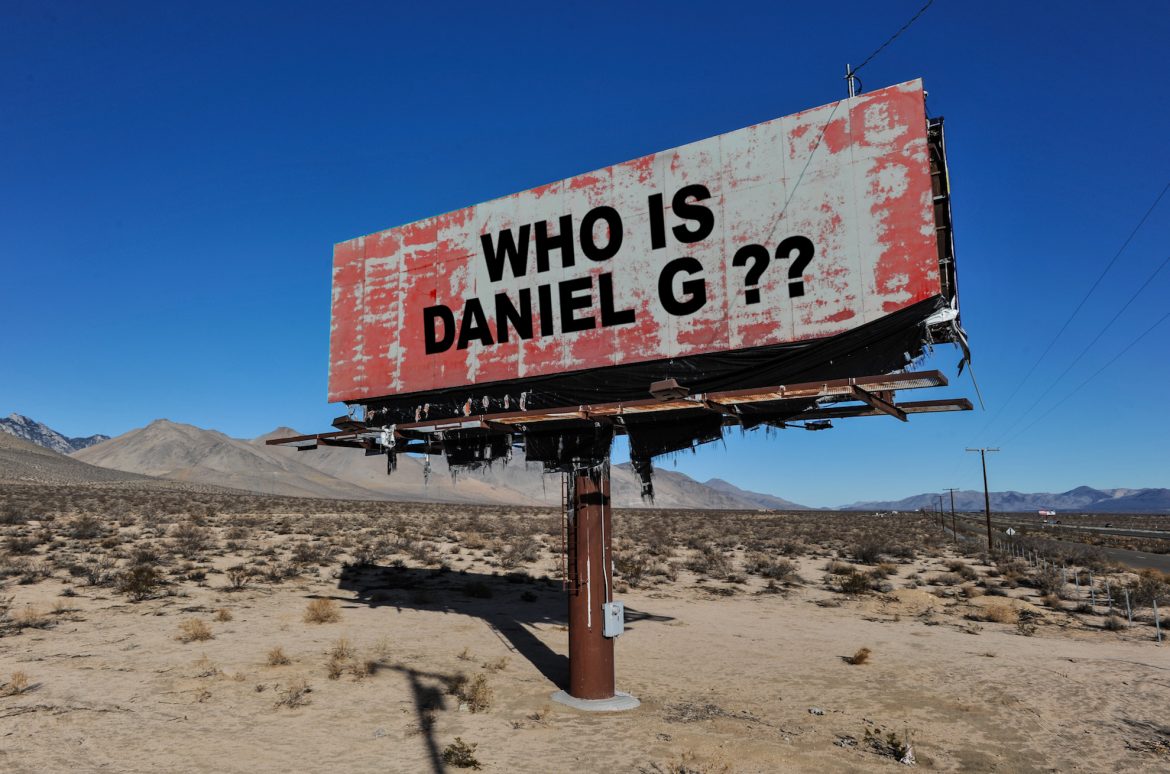
Who Is Daniel G? A New Suspect Emerges

Last week we reported on an evolving mystery out of Portland, Oregon, where multiple coffee companies had received the same handwritten complaint letter requesting a replacement for “stale” coffee. But quickly we learned this was not just a Portland phenomenon—first dozens, and now more than 100 brands have contacted Sprudge over the last week, having received their very own identical Daniel G. letters from the same name and address in Nevada.

You’ve graciously sent us photos of your letters, from coffee brands big and small, in urban metropoles and rural hamlets alike. We’ve been deluged with clues, red herrings, false leads, and no shortage of what appear to be legit customer service complaints and requests for refund misidentified as Daniel G. communications. Sleuthing is currently underway behind the scenes to establish more information about the sender, to confirm their identity, and to shed light on the truth behind this mystery, one of the great coffee grifts of all-time.

Today we need your help. 

While we’re currently tracking a suspect (or suspects) to an address in Las Vegas, another possibility has emerged over the last few days, tied to a chain of letters sent out from a different Nevada address—and with a different name attached. This new suspect made our hair stand on end. We have reason to suspect they may be connected to the person or persons responsible for the Daniel G. letters.

Here’s one of the letters, sent from Reno, NV by a new suspect we’re calling Person T:

If Person T is indeed connected to the massive set of Daniel G. letters, this would be a bombshell new development, one with implications stretching several years. Person T has lead us to investigate a disturbing set of truths behind who, exactly, is sending these letters, and why.

The letter above bears some connection with the Daniel G. letters but also carries with it several discrepancies. This is far from a home run—we are not claiming definite knowledge or certainty that the letters are connected. But we’re sharing this with you today to see if others have received letters in the style of Person T over the last decade, and to request those who have to get in touch with us immediately.

Here’s another letter from Person T:

Connected? Random? An early example of what would go on to become Daniel G.? Here’s a quick outline as we see it:

Connections

1. Similar MO — both letter writers are sending hand-written, unrequested mailings to specialty coffee companies around the country over the last half-decade. The earliest Person T letter we’ve seen dates to 2013. The earliest confirmed Daniel G. letter dates to 2016.

2. Odd grammar — both letters include unusual uses of punctuation and grammar.

3. “Sincerely” — both letters end with a handwritten “Sincerely,” sign-off.

4. Nevada — both letters were sent from a return address in Nevada.

5. Return letter stickers — both sets of letters include pre-printed “return letter” stickers, of a similar make and style, in place of a handwritten address on the envelope.

6. Block address — both sets of letters include handwritten block addresses within the body of text.

7. Lined paper — both letters are sent on blue-lined notebook paper of a similar style.

8. No digital footprint — both letters contain absolutely no information about how to contact the sender aside from a return address. No email, no phone number, no social media handles, and no website.

Discrepancies

1. Handwriting —  a cursory view of the handwriting between each letter seems to suggest that it’s not an exact match. We’re following up with a handwriting expert this week to learn more.

2. Different address — Person T is writing from Reno, while Daniel G is writing from Las Vegas, more than 400 miles away.

3. Different request — Person T is simply requesting a sale sheet; Daniel G. demands replacement coffee and an explanation.

4. Letter variation — the Person T letters we’ve seen so far all differ slightly—some are multiple paragraphs, others are just two sentences. Daniel G.’s emails are all of an identical link and style.

So far only a few coffee companies have checked in with letters from Person T, but we have reason to believe there could be many more letters of a similar style sent all over the United States, dating back to as early as 2013. We’re keeping those coffee brands anonymous for now because the more we learn about Person T, the more we uncover disturbing information tied to their name—and past convicted crimes.

Here are a few more of these letters from Person T:


Have you seen letters like this before? At any point in the last decade were you contacted via mail with a handwritten letter asking for a “sell sheet” or “toll-free” number? Does this jog your memory, ring bells, or remind you of something you’ve received before? Get in touch with us. We have reasons to believe this could be connected with the saga of Daniel G.

More news as it develops this week, only on Sprudge.

E-mail us.

1-888-55-SPRUDGE

@Sprudge on Instagram 

The post Who Is Daniel G? A New Suspect Emerges appeared first on Sprudge.


from RSSMix.com Mix ID 8200593 http://sprudge.com/who-is-daniel-g-a-new-suspect-emerges-135162.html

A Guatemalan Coffee Crisis Is Leading To Greater Rates Of Migration

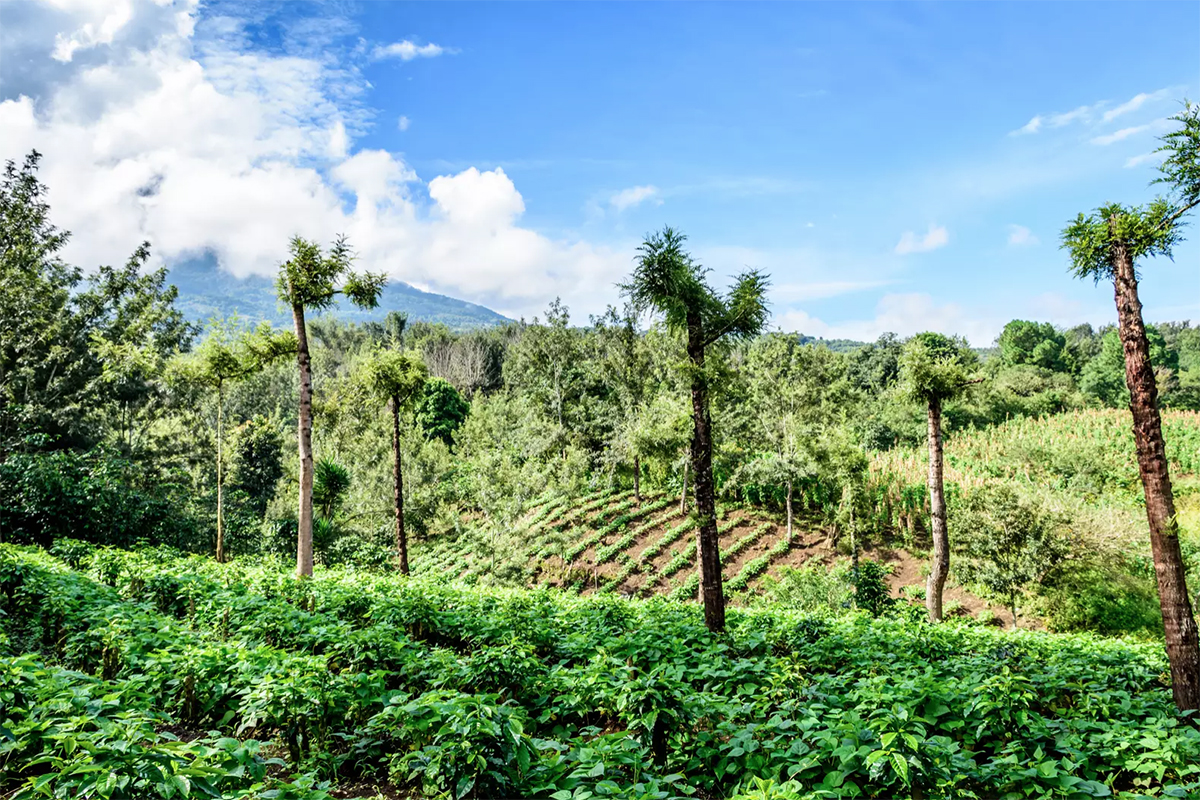
Coffee production in Guatemala is facing a new crisis. No, it’s not roya, climate change, or low coffee prices. It’s all of them, and they are causing greater numbers of workers and some landowners to abandon the coffee farms and migrate north to the United States.

“You have two options in this part of Guatemala: grow coffee or migrate,” says Cipriano Juventino Niz Chilel, the president of the Entre Rios coffee cooperative in San Pablo.

According to a recent article in Time, Guatemala has undergone three decades of migration. Civil war in the ‘80s, “economic crisis, grinding poverty, and natural disasters” in the ‘90s and ‘00s, and gang and domestic violence in current years have all led of hundreds of thousands (of a population of 16.5 million) with no option but to relocate north.

And now troubles with the coffee industry are causing even more to leave. The roya outbreak in 2011 decimated 20 percent of the coffee crop, having a particularly devastating effect on higher-end Arabica varieties. The leaf rust outbreak has only been exacerbated by climate change, with “warmer temperatures spreading the disease to higher altitudes” and also “[increasing] the frequency of droughts, floods, and cold shocks, which can decrease, or at times completely destroy, production.”

At the same time, countries like Brazil, Vietnam, and Honduras had particularly good yields, leading to a drop in the price Guatemalan coffees could fetch. Whereas producers were at one time able to get $170-180 per 100 pounds of coffee, prices today stand around $110, lower than the cost of investment it takes to produce the coffee.

With no money to be made in the coffee field, many Guatemalans are forced to migrate. And according to Time, whereas many would head for Guatemala City, low wages and gang violence have made the journey to the United States much more appealing.

To stay afloat, many coffee farms are taking the advice of ANACAFÉ—Guatemala’s national coffee association—and diversifying their crops to include bananas, plantains, and macadamia nuts. This, the article notes, will help the farms survive the current price dip, but it does little to affect employment, as the new crops don’t require near the same number of people to harvest as coffee does.

It’s easy to forget, especially for those of us not living with the circumstances everyday, that these issues don’t exist in a vacuum. Climate change, unrest, violence, immigration, untenable coffee prices: they are all connected.

Zac Cadwalader is the news editor at Sprudge Media Network and a staff writer based in Dallas. Read more Zac Cadwalader on Sprudge.

Top image via Time.

The post A Guatemalan Coffee Crisis Is Leading To Greater Rates Of Migration appeared first on Sprudge.


from RSSMix.com Mix ID 8200593 http://sprudge.com/a-guatemalan-coffee-crisis-is-leading-to-greater-rates-of-migration-135133.html

First Look Inside The New Brooklyn Stumptown Coffee Roasters

stumptown coffee brooklyn new york

stumptown coffee brooklyn new york

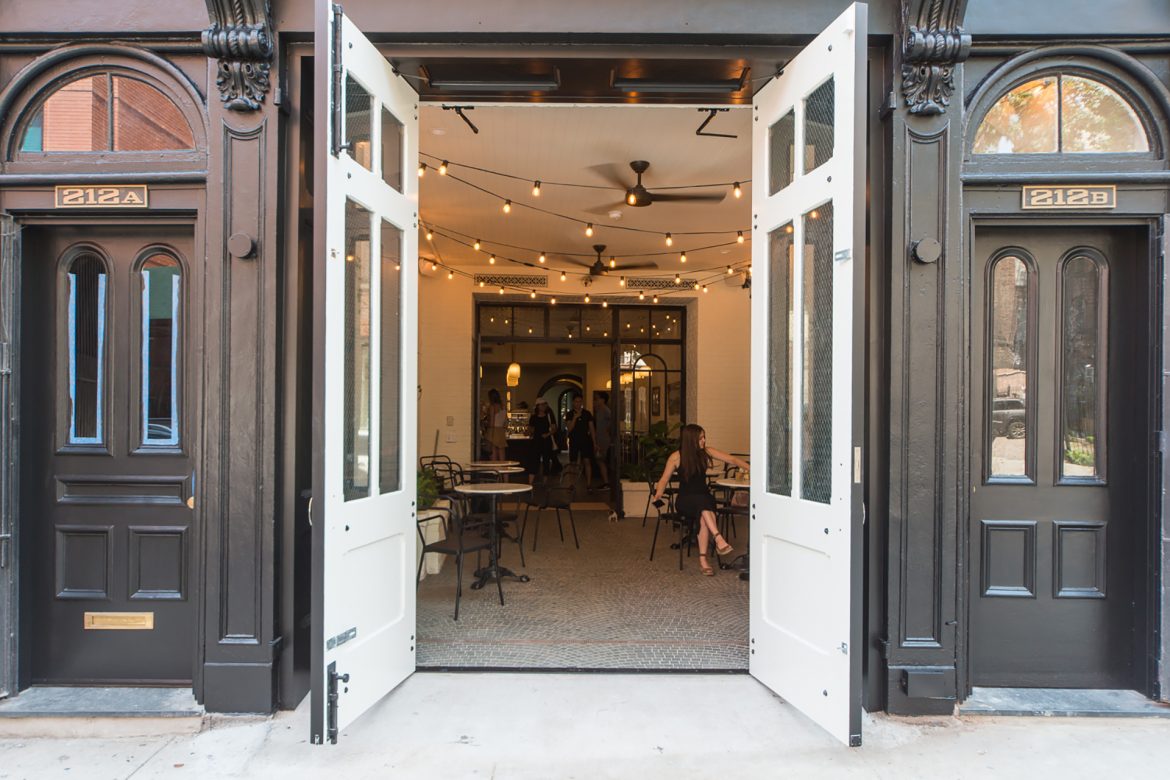
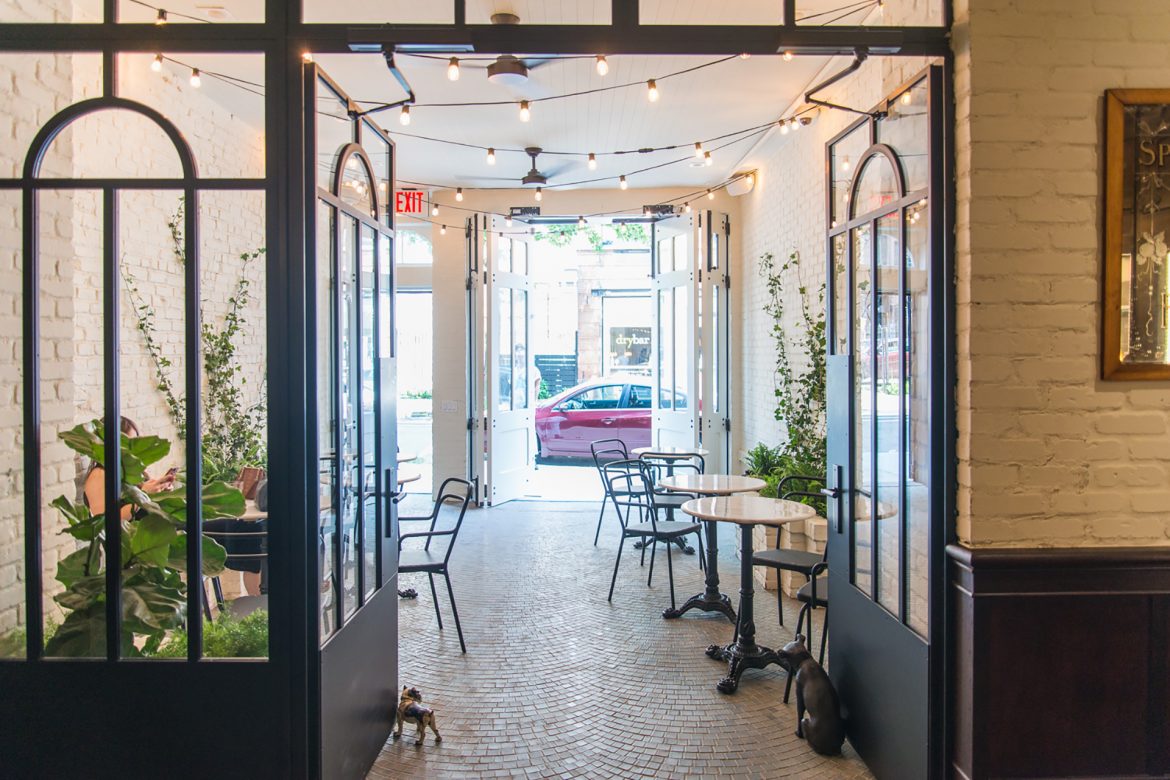
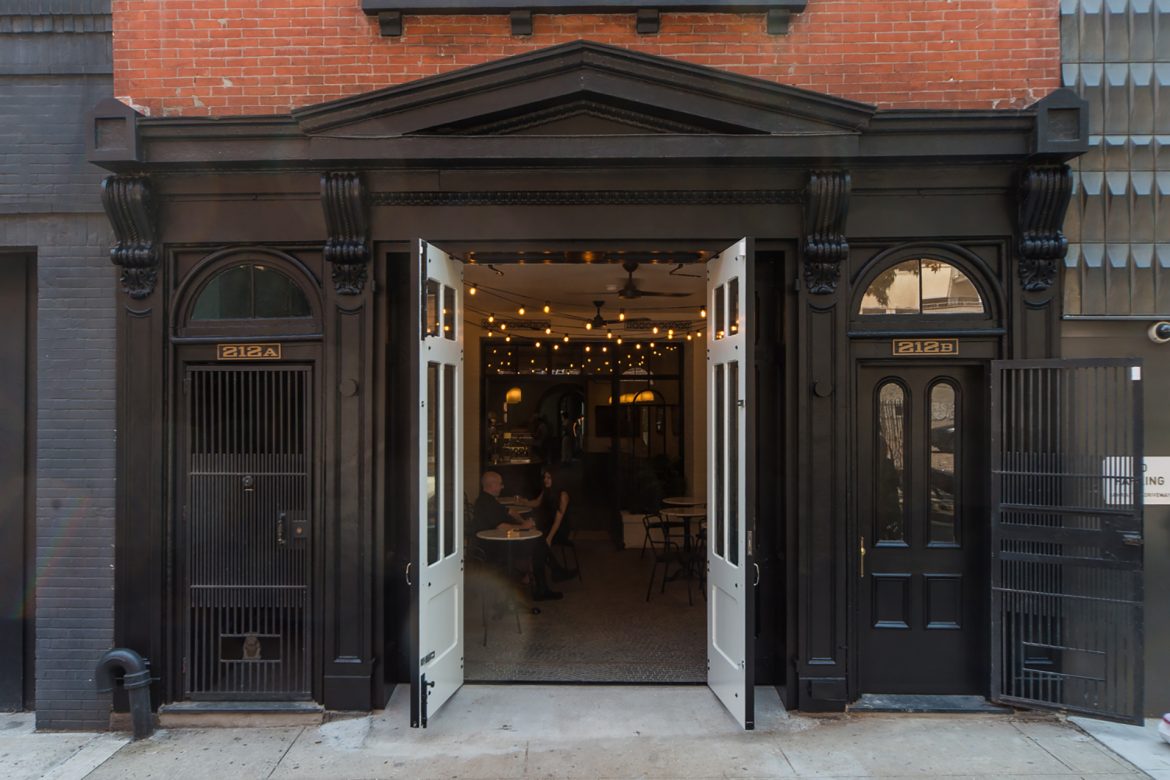
Breaking today here on Sprudge, Stumptown Coffee Roasters is now open in Cobble Hill. The Portland-based brand launched a new cafe today inside of an 1860’s Brooklyn firehouse, located at 212 Pacific Street. They’ll be celebrating all day long with a series of events, readings, and the occasional impromptu drumline, so if you’re reading this from Brooklyn, get thee to the Hoyt-Schermerhorn stop, served by the A, G, and sometimes C trains.

In the works since late 2017, Stumptown marketing director Mallory Pilcher describes the cafe as “a singular vision driven by several different people” within Stumptown’s national team. “There were a lot of chefs at the table,” Pilcher says, “and we collaborated in this project across departments to achieve a soulful creation.”

stumptown coffee brooklyn new york

stumptown coffee brooklyn new york

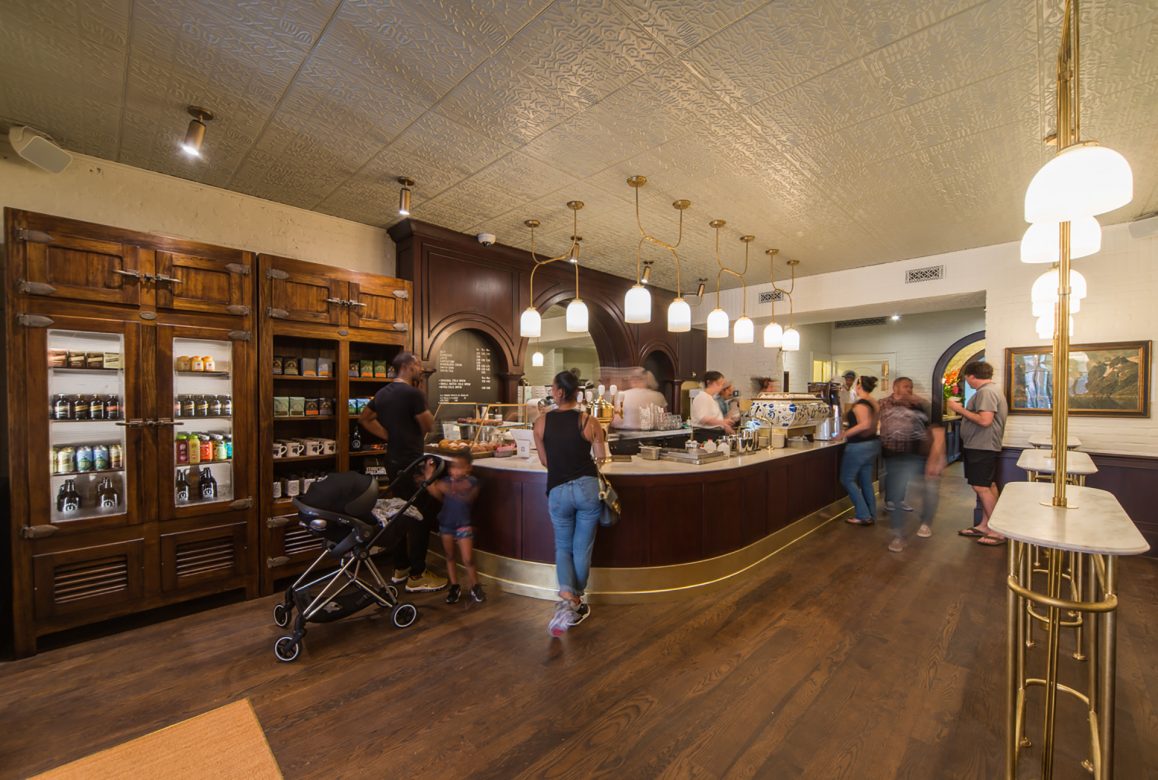
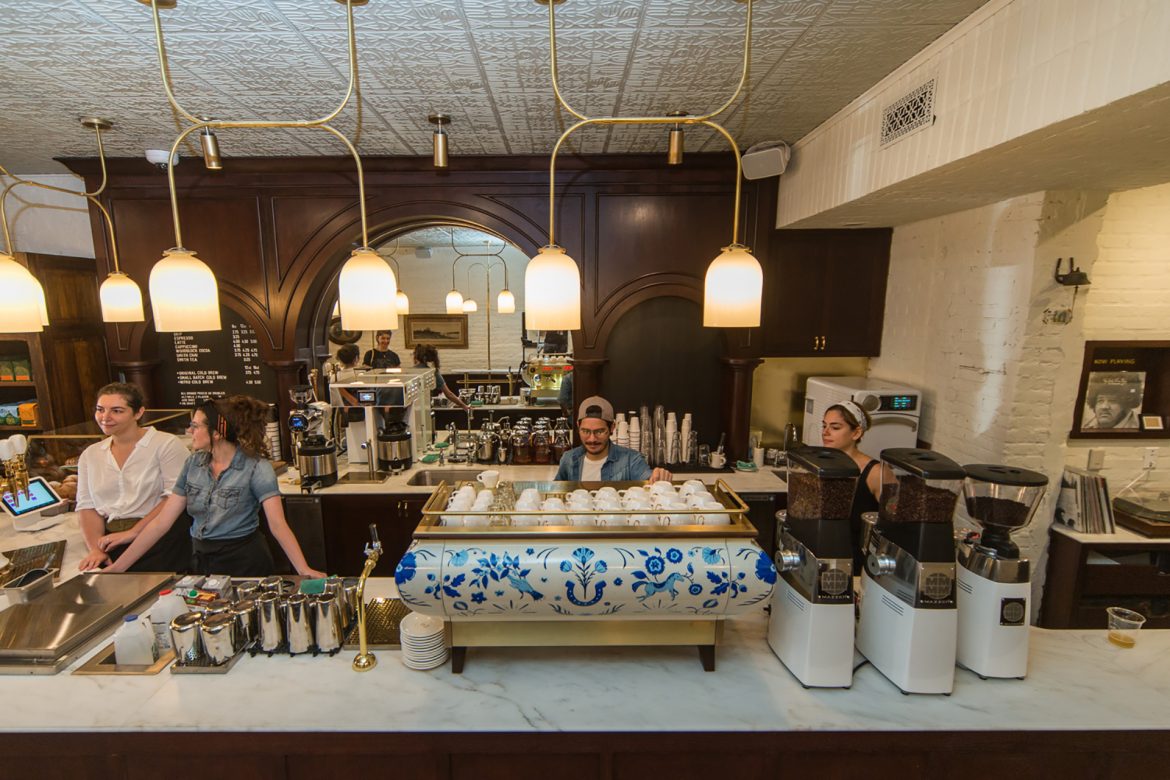
To be clear, this is not an imagined interpretation of a pre-Civil War firehouse based on preserved architectural documents—it is an actual 150-year-old building, which first served the neighborhood as a fire department way back in the 19th century, and had most recently functioned as an indoor archery studio. Through the space’s gorgeous white brick foyer, past the flowers, you enter a grand cafe main room with retail wall, coffee bar, and marble floating tables with intricate brass work underneath, evoking a vintage subway car.

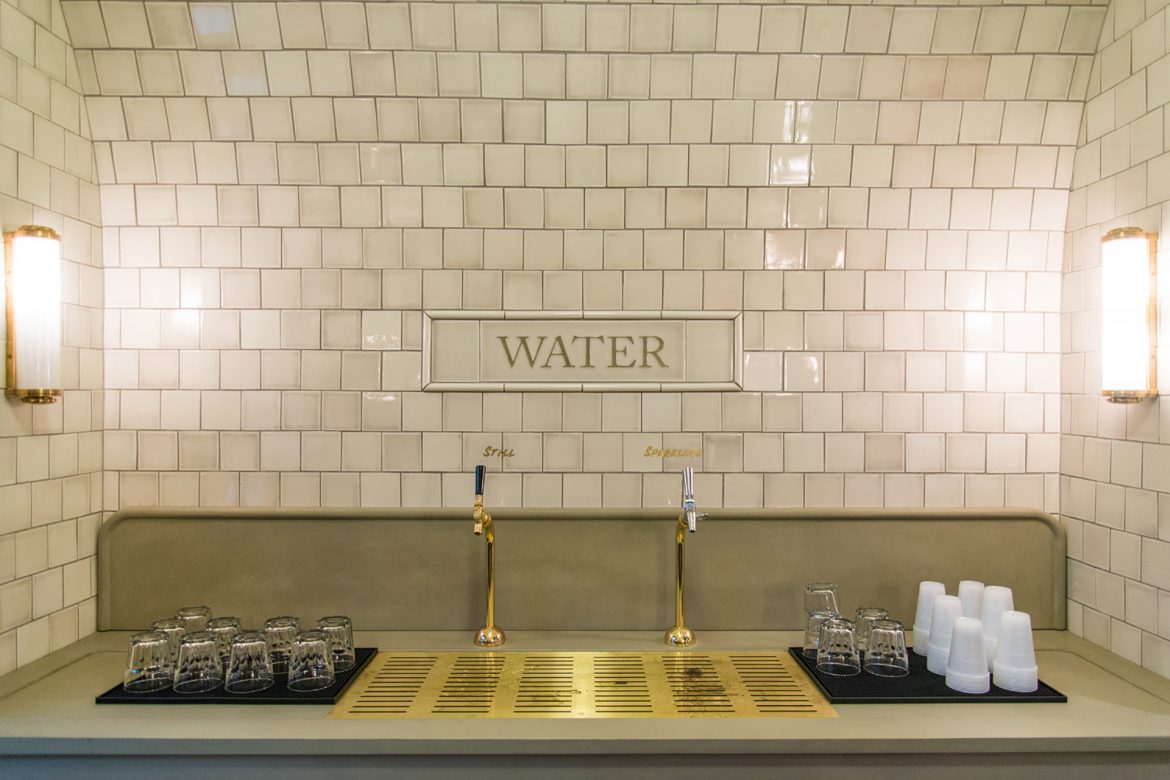
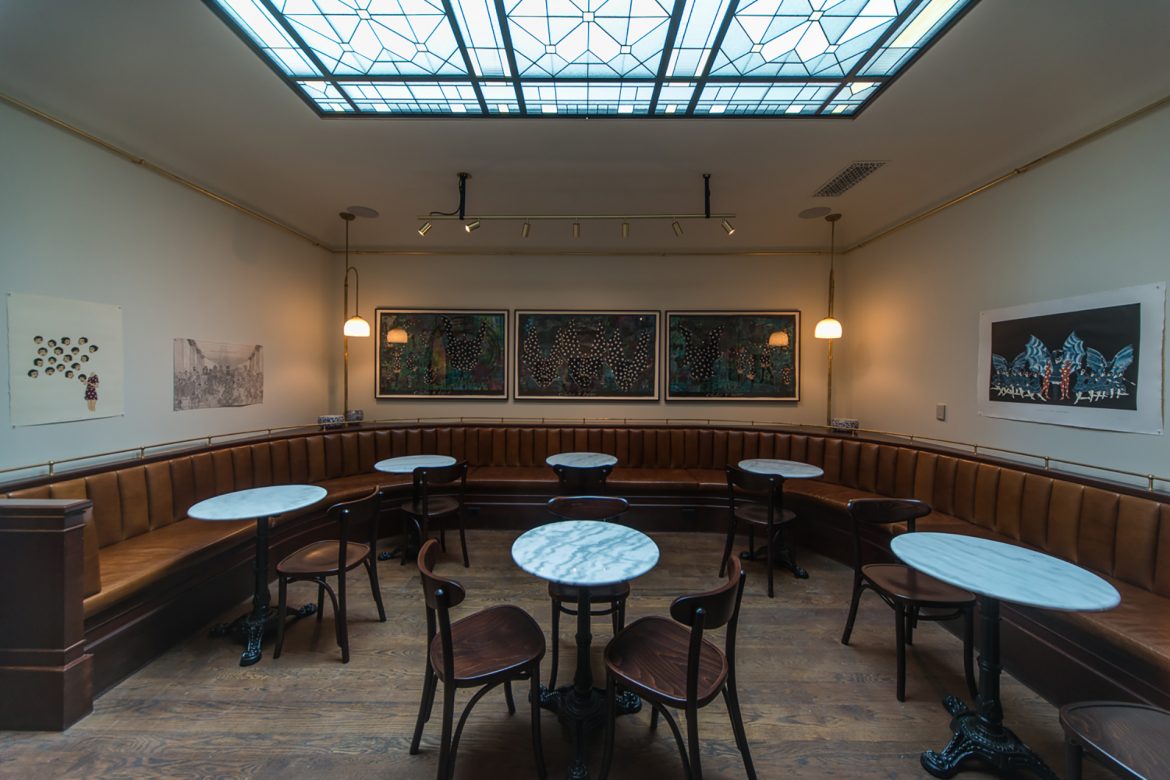
Continuing towards the back of the space you pass through a middle corridor, featuring more flowers, a water and magazine station, and finally into the back room, featuring wrap-around banquette seating offset by an original work from renowned Brooklyn artist Marcel Dzama.

stumptown coffee brooklyn new york

stumptown coffee brooklyn new york

Original triptych by Marcel Dzama, titled “To Rise and To Fall and To Rise and To Fall and To Rise and To Fall Again, 2018”

This is Stumptown first proper cafe in Brooklyn, following their roasting HQ and tasting room in Red Hook. The space’s design is a fusion of Brooklyn and Portland elements, featuring architecture from NYC’s own TBD Architecture + Design Studio paired with the vision of Portland’s Jessica Helgerson Interior Design, alongside custom design work by Zachary Marvick, also of Portland.

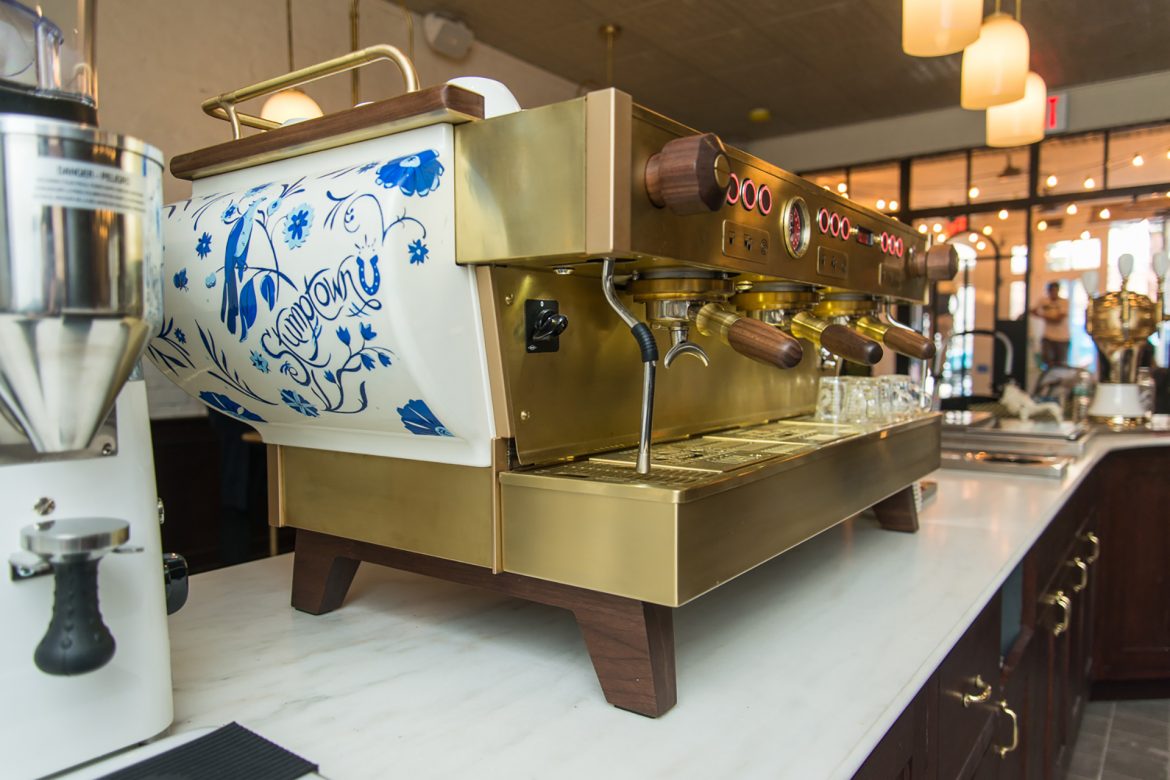
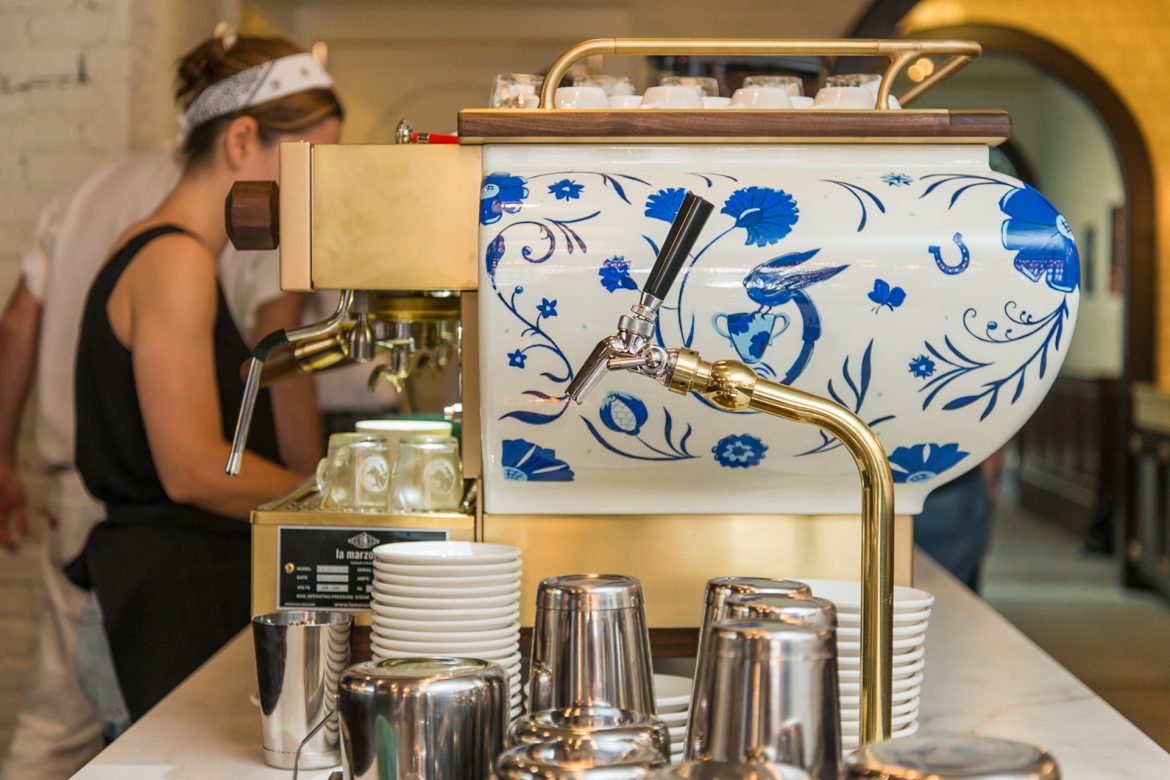
The cafe’s drinks menu includes a standard battery of established Stumptown offerings, including espresso via an eye-catching La Marzocco Linea PB, with customization work by Pantechnicon and hand-drawn art by Melanie Nead. Gear by Curtis and Mazzer help anchor the bar, which also features cold brew taps and pour over drinks, along with a few more Portland favorites like Woodblock Chocolate and Steven Smith Teas. There’s a significantly expanded food offering here in partnership with Lalito, chef Gerardo Gonzalez’s lauded San Diego (by way of Meso-America) restaurant in lower Manhattan. Think carnitas burritos, coconut rice bowls, and chef’s ever-popular banana tahini bread.

stumptown coffee brooklyn new york

stumptown coffee brooklyn new york

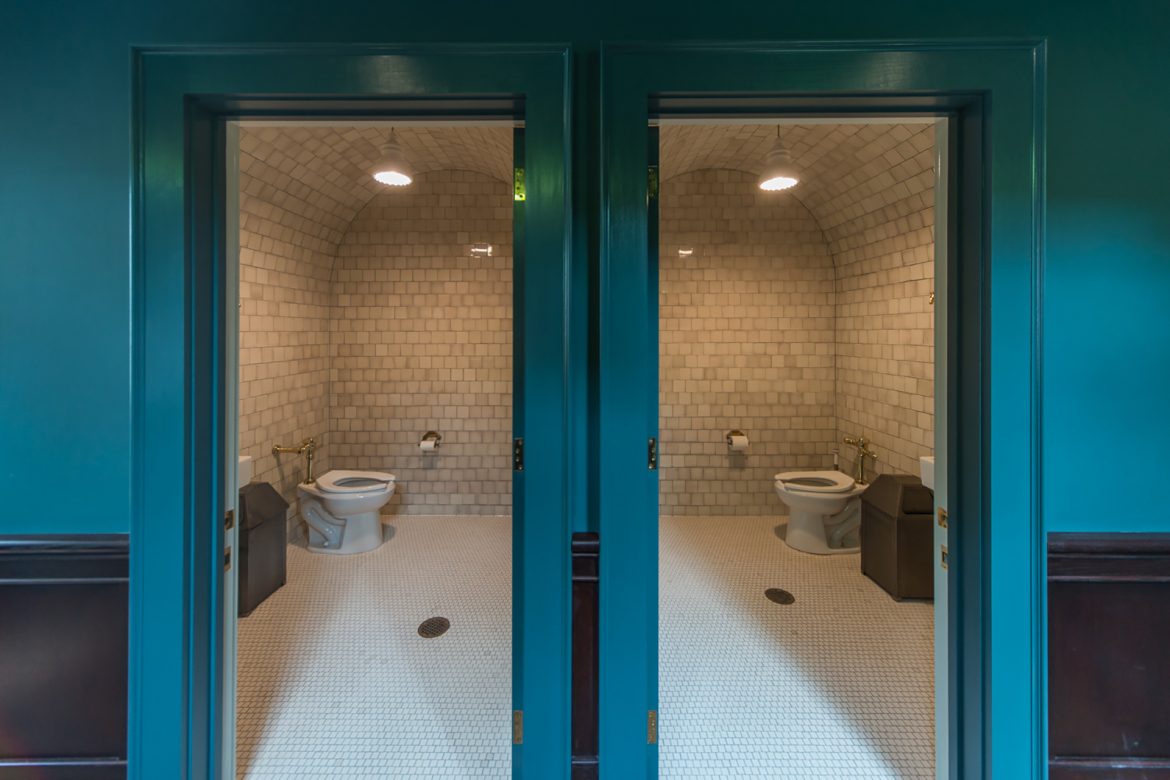
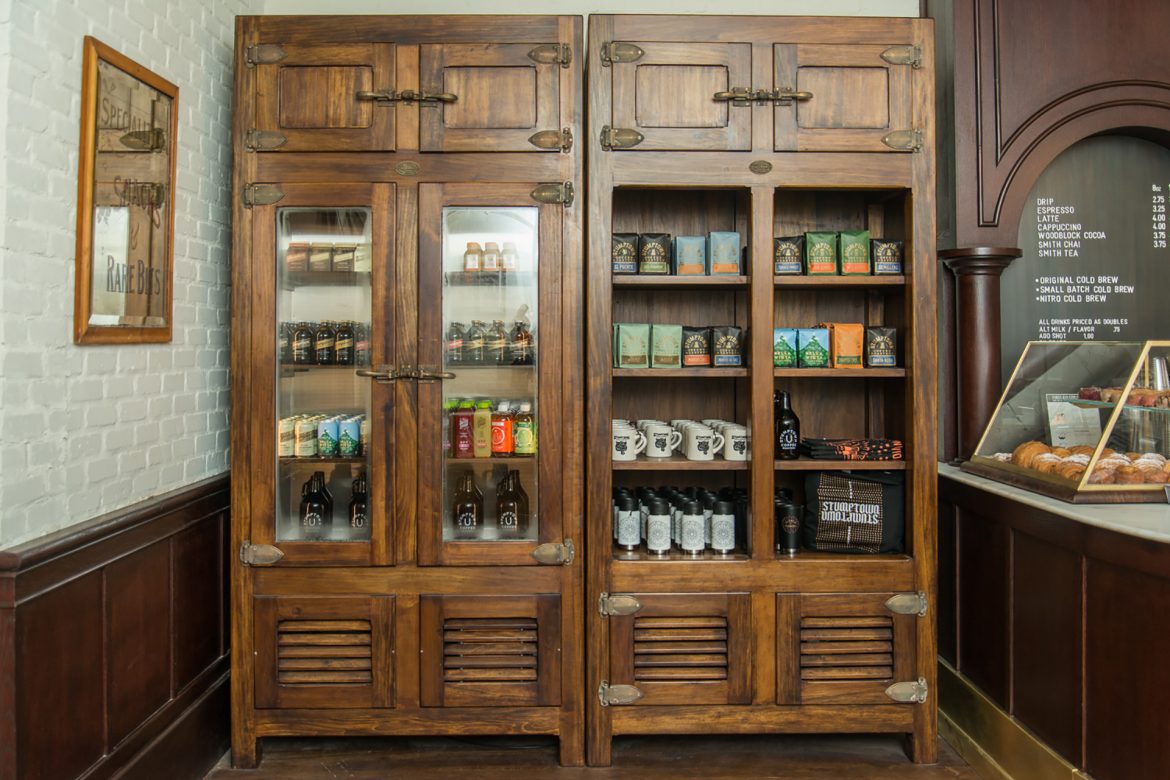
A series of community events celebrate today’s launch, including readings from Books are Magic, sweeties from Du’s Donuts, and a performance from Brooklyn United Music & Arts Program. But you’ll be forgiven if you’d like to simply walk in and wander about, picking out little details across the space—the classic brass fittings, antique retail shelves and converted fridges, and white subway tile everywhere. But when queried on her favorite element of the design, Pilcher told us candidly, “The bathrooms!”

stumptown coffee brooklyn new york

stumptown coffee brooklyn new york

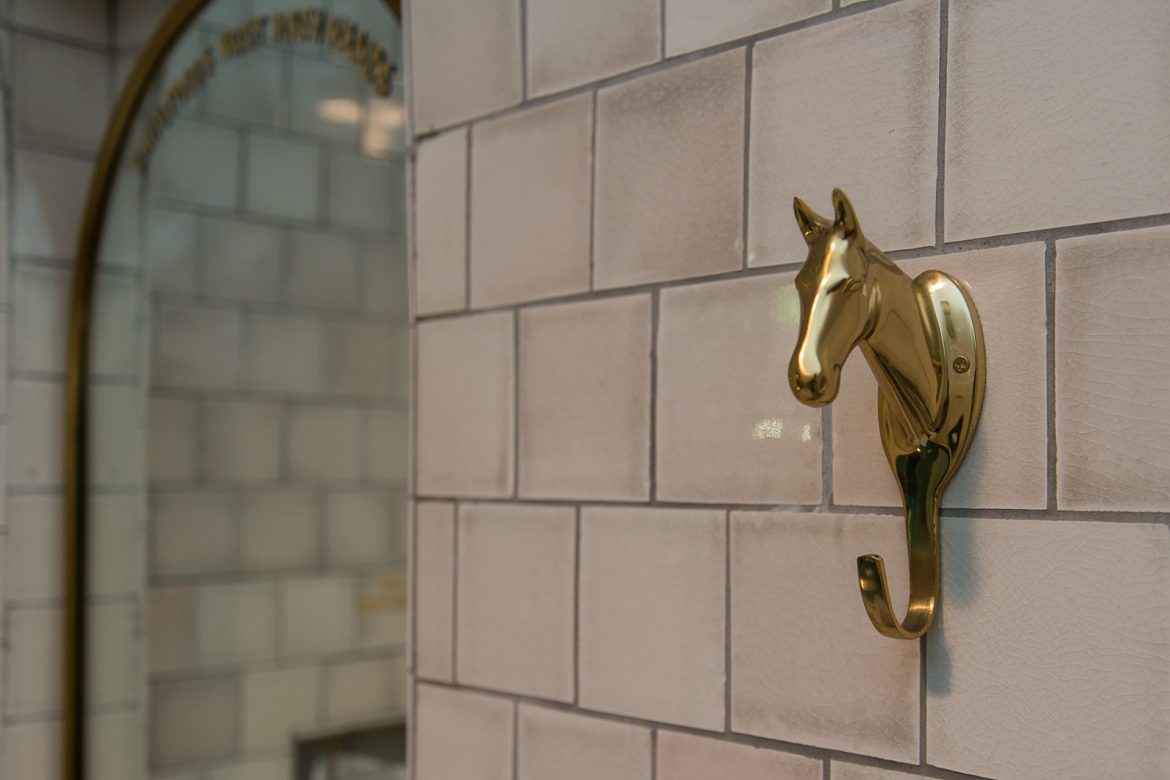
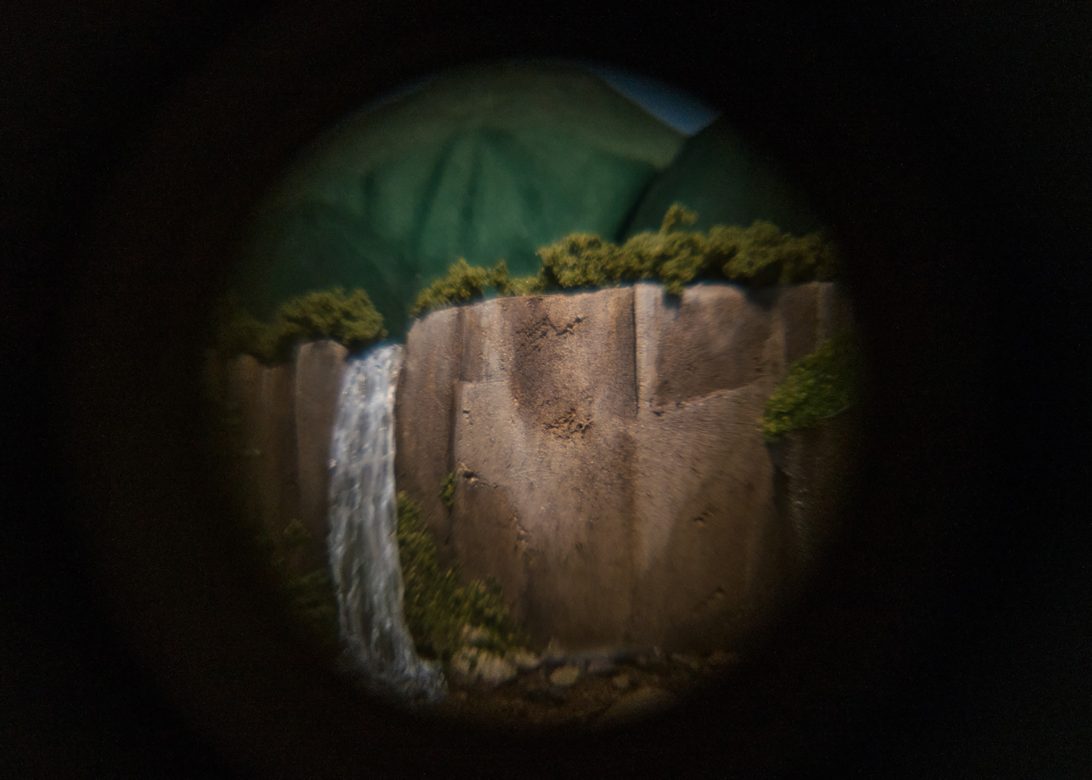
Her pick is hard to argue with—these loos feature sweeping arches overhead, and include a host of little design quirks like horsey coat hangers and whimsical peepholes. “New York is so chaotic and insane,” says Pilcher, “and it can feel like the restroom is the only solace you get all day here. These ones are really beautiful and I love them.”

Check out one of those special peephole designs below, then peruse out even more images from inside the new cafe, with photos by Sprudge contributor and Brooklyn resident D. Robert Wolcheck.

stumptown coffee brooklyn new york

stumptown coffee brooklyn new york

stumptown coffee brooklyn new york

stumptown coffee brooklyn new york

stumptown coffee brooklyn new york

The new Stumptown Cobble Hill is located at 212 Pacific Street, Brooklyn, New York 11201. Hours daily from 6:30am to 7pm.

Jordan Michelman is a co-founder and editor at Sprudge Media Network. Read more Jordan Michelman on Sprudge. 

Photos by D. Robert Wolcheck for Sprudge Media Network. 

Disclosure: Stumptown Coffee Roasters is an advertising partner on the Sprudge Media Network. 

The post First Look Inside The New Brooklyn Stumptown Coffee Roasters appeared first on Sprudge.


from RSSMix.com Mix ID 8200593 http://sprudge.com/first-look-inside-the-new-brooklyn-stumptown-coffee-roasters-135134.html

The Coffee Lover’s Guide To Traverse City, Michigan

traverse city michigan coffee guide

traverse city michigan coffee guide

There’s a colloquialism that the Great Lakes region is America’s Third Coast, and it’s easy to see why. Standing in Michigan on the shores of the state’s titular lake, with sandy beaches stretching in both directions and a colossal blue sky overhead, you could easily be looking out to the Pacific Ocean. 

Specialty coffee in the state is, understandably, concentrated in its southernmost urban centers—Grand Rapids, Ann Arbor, and Detroit. There are outliers further north—both Lansing and Bay City have burgeoning coffee scenes—but Michigan’s northern resort towns have historically lagged behind.

That’s beginning to change. Traverse City, with an enviable lakeside location on the northwestern tip of Michigan’s glove, is undoubtedly a tourist epicenter. The town has, over the years, served as a gateway to the area’s myriad summer attractions—from hiking and fishing to winery tours and festivals—while itself generating a reputation for producing food, wine, beer and now coffee.

When visiting, it can be easy to just linger in and around Traverse City, but it’s worth taking the time to explore the countryside further out to get a real taste for what Michigan has to offer. To that end, here’s a list of coffee to enjoy the next time you’re in Traverse City, and one option to seek out if you find yourself further north.

A quick note for vegan-conscious vacationers: in a sign that the alternative milk wave has reached even this far north, oat milk is available at every cafe in this guide, which made my wife very happy.

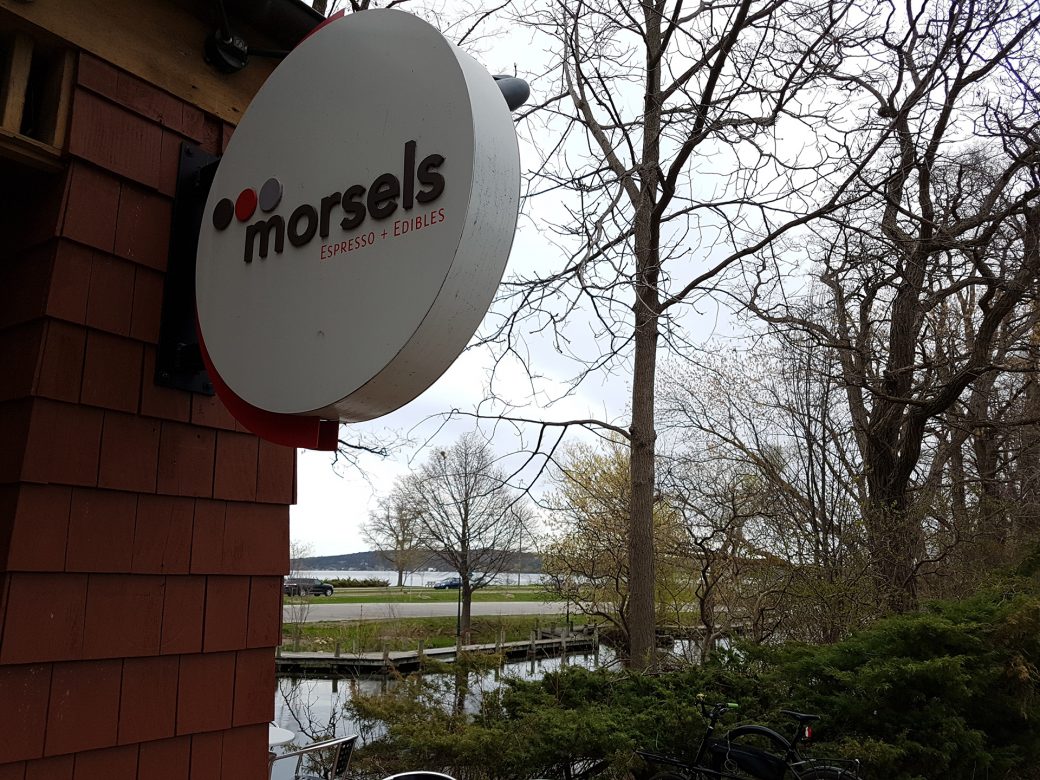
Morsels Espresso + Edibles

traverse city michigan coffee guide

Located on the east side of downtown Traverse City, with an outside seating area on the banks of the Boardman River and views out to West Grand Traverse Bay, Morsels Espresso + Edibles is a good place to start a coffee tour. A short stroll down Front Street from the bustling, touristy heart of Traverse City, Morsels lends a sense of calm—away from the crowds, surrounded by trees and water.

Although known primarily for the tiny cake bites that give the company its name (which include pun-tastic options such as Espresso Yourself and Matcha Made In Heaven), Morsels’ coffee lineup is not to be ignored. Intelligentsia provides the coffee, a La Marzocco GB5 cranks out espresso from atop a big granite counter, while Chemex and Hario V60 options are also available for those so inclined.

Seating here is plentiful and comfortable, and although it was quiet at the beginning of the summer season, it’s easy to see Morsels being inundated with customers at its peak. Pairing one of their bite-sized cakes with a Black Cat Espresso cortado makes it a worthy first stop.

Morsels Espresso + Edibles is located at 321 E Front St, Traverse City. Visit their official website and follow them on Facebook, Twitter, and Instagram.


Planetary Coffee

traverse city michigan coffee guide

Handily, the next cafe in this guide is less than a block directly south of Morsels.

Planetary Coffee started life, like so many coffee companies before them, inside a truck, traveling the streets of Traverse City and the surrounding area to serve coffee at various events, from farmer’s markets to summer festivals.

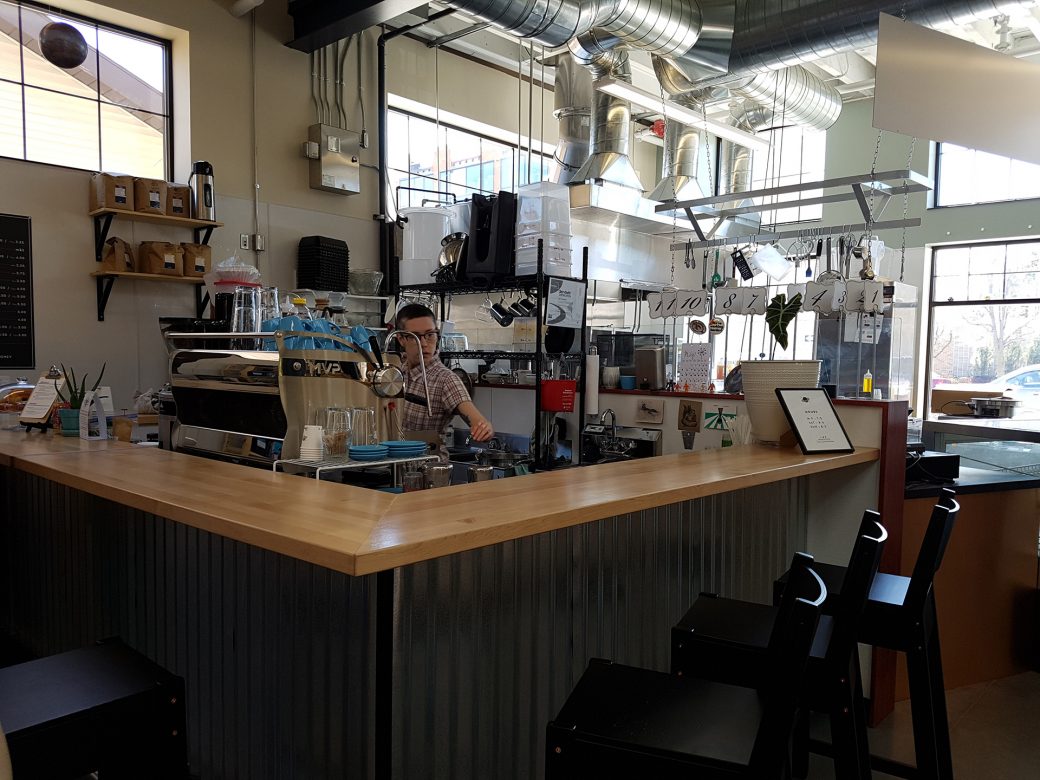
In December 2017, they moved to a more permanent home inside the State Street Marketplace, an indoor market featuring food, beer, vintage clothing, and more. This huge, light-filled space makes Planetary seem much bigger than it really is—there is a shared seating area in the center of the market, and an outside patio for when the weather warms up.

Using a Synesso MVP and Mahlkönig grinders, Planetary makes espresso drinks with Halfwit Coffee Roasters from Chicago. If lattes aren’t your thing they do a stellar cold brew, as well as house-made chai and the requisite pour-over options.

Planetary is the definition of starting small and growing smartly. As their following continues to increase around Michigan, and their coffee truck continues to be in demand over the summer months around the city, even more growth is sure to come.

Planetary Coffee is located at 329 E State St, Traverse City. Visit their official website and follow them on Facebook, Twitter, and Instagram.


BLK\MRKT

traverse city michigan coffee guide

To reach the next stop, you have to walk back down Front Street, through the throngs of vacationers debating which brewpub to choose for lunch, maybe stopping to glance upwards at the State Theatre’s gorgeous marquee. If you come during the Traverse City Film Festival in early August, there’s a good chance you’ll bump into Michael Moore, the festival’s founder, wandering around downtown. You might even run into him at our next cafe.

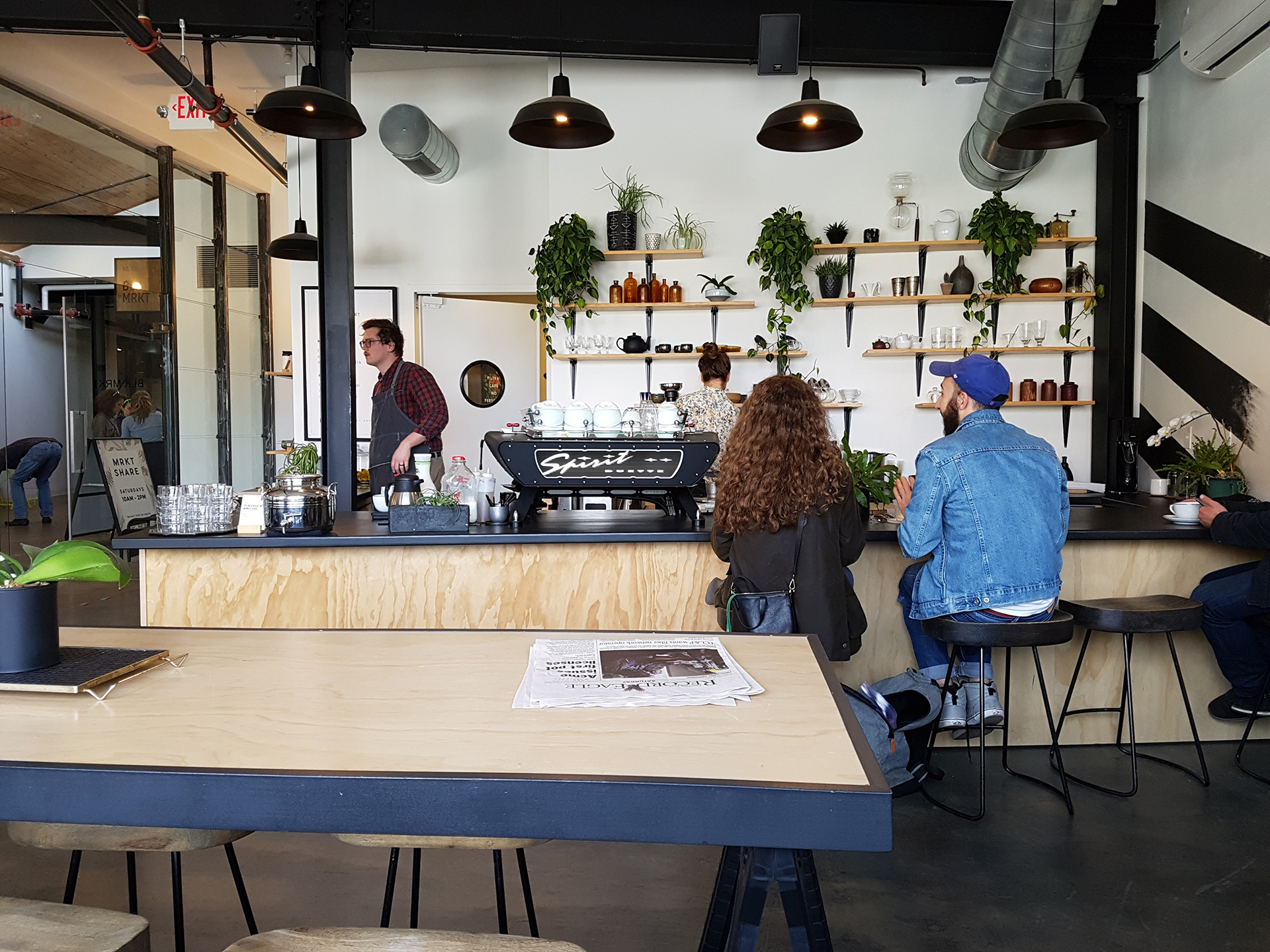
In the Warehouse District to the west of downtown, just past another brewpub, lies BLK\MRKT, situated inside the upscale Warehouse MRKT retail center. The brainchild of Traverse City native (and Morsels alum) Chuck Korson, BLK\MRKT’s ambiance is influenced by the former warehouse it calls home. A subdued palette, clean design, and abundance of natural light is balanced with greenery from houseplants dotted around, as well as original artwork on the walls.

A low bar and equally low-slung Kees van der Westen Spirit espresso machine gives the space a cohesive feel, allowing for less of a separation between barista and customer while drinks are being prepared. Speaking of drinks, BLK\MRKT uses a rotating selection of guest roasters—currently Brooklyn’s Parlor Coffee—alongside their own in-house roasted coffee

BLK\MRKT is as high-end a coffee experience as you’re likely to find in these parts, and wouldn’t be out of place in San Francisco or Chicago. The fact that it’s hiding away in Northern Michigan makes it more special, somehow—a secret waiting to be discovered.

BLK\MRKT is located at 144 Hall St, Traverse City. Visit their official website and follow them Facebook, Twitter, and Instagram.


Higher Grounds Coffee

traverse city michigan coffee guide

To reach the penultimate coffee stop, you’ll need transportation of some kind.

On the southwest edge of downtown Traverse City, where the town begins to bleed out into the countryside, lies The Village at Grand Traverse Commons, formerly known as the Traverse City State Hospital and, before that, the Northern Michigan Asylum. The Village is an ambitious renovation project, turning the derelict (and faintly spooky) former asylum into apartments, shops, and restaurants, as well as 480 acres of conservation area surrounding it.

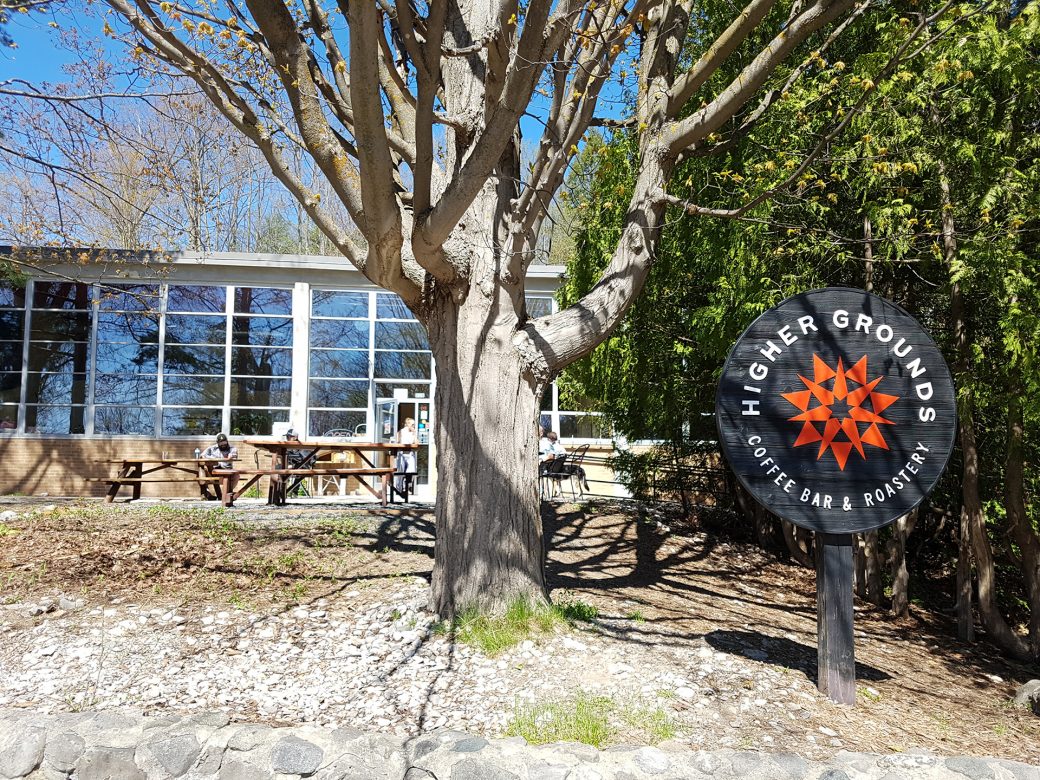
Higher Grounds Coffee shares a former laundry with the Left Foot Charley winery on the outer edges of the development, with a shared patio overlooking a green expanse of lawn that leads down to the main complex. Although ostensibly a coffee bar attached to a wholesale roastery, Higher Grounds offers a warm and welcoming environment, with lots of tile and wood and floor-to-ceiling windows to let in the sunshine.

A La Marzocco Linea Classic, supported by Mahlkönig and Mazzer grinders, provides espresso drinks, while a large selection of Higher Grounds coffees are available for pour-over. They also offer creative specialty drinks—The Buzz, made from honey and soda mixed with espresso and served over ice, is particularly refreshing on a warm spring day.  

The neighborhood coffee house feel that Higher Grounds has generated extends to the takeaway coffee cup options, of which there are none. Instead, there is a wall of donated ceramic mugs that customers are welcome to take with them, return, or just keep. There are spots for recycling and even composting, all of which connects to Higher Grounds’ wider environmental and social goals, such as offering year-round bicycle delivery in Traverse City, or building schools in Ethiopia.

Higher Grounds Coffee is located at 806 Red Dr, Traverse City. Visit their official website and follow them Facebook, Twitter, and Instagram.


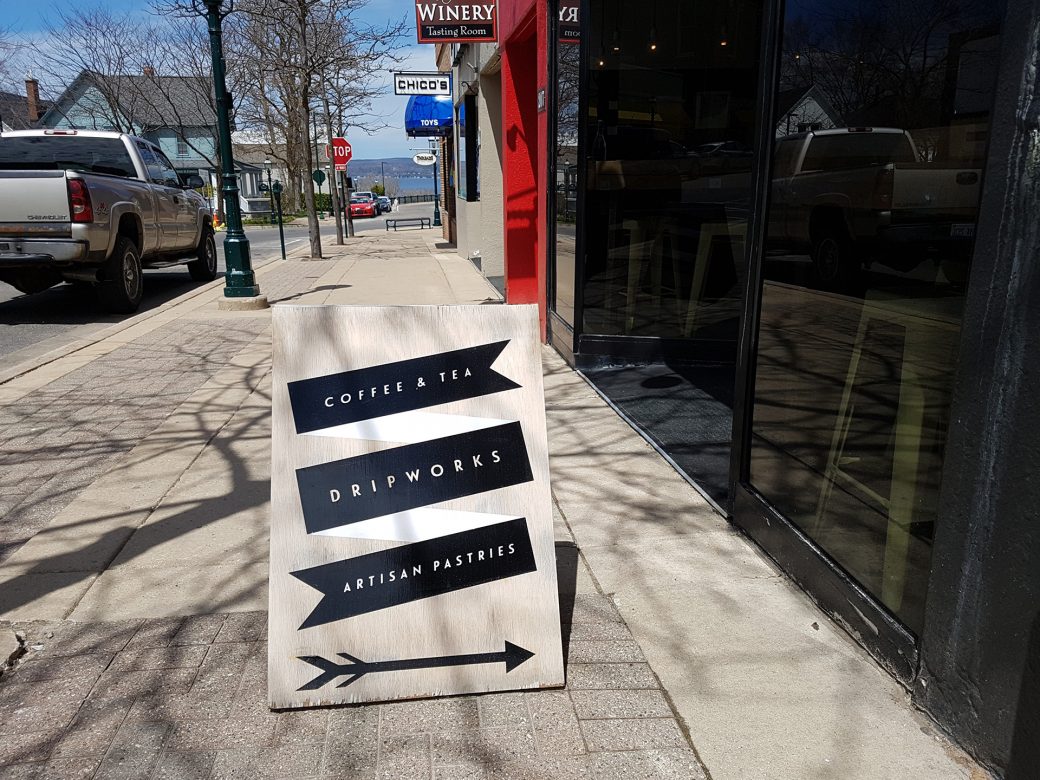
Dripworks

traverse city michigan coffee guide

For the last leg of our Northern Michigan coffee tour, you’ll need to drive out of Traverse City, hugging the shore of Lake Michigan as US-31 winds its way northwards, past vineyards and through sleepy resort towns for about an hour and a half until you reach Petoskey.

Why Petoskey, you might ask? Well, aside from its claim to fame as the birthplace of The Blacklist star Megan Boone, it’s also the home of Dripworks Coffee, located in the historic Gaslight District just across US-31 from Petoskey’s picturesque marina.

A specialty cafe crossed with a French pâtisserie, Dripworks was formed by Northern Michigan natives Danielle Charles and Mike Davies. After living in Seattle and Vermont, as well as a year in London, the pair was inspired to bring what they’d learned abroad back to their home state by opening their own ideal coffee shop and bakery.

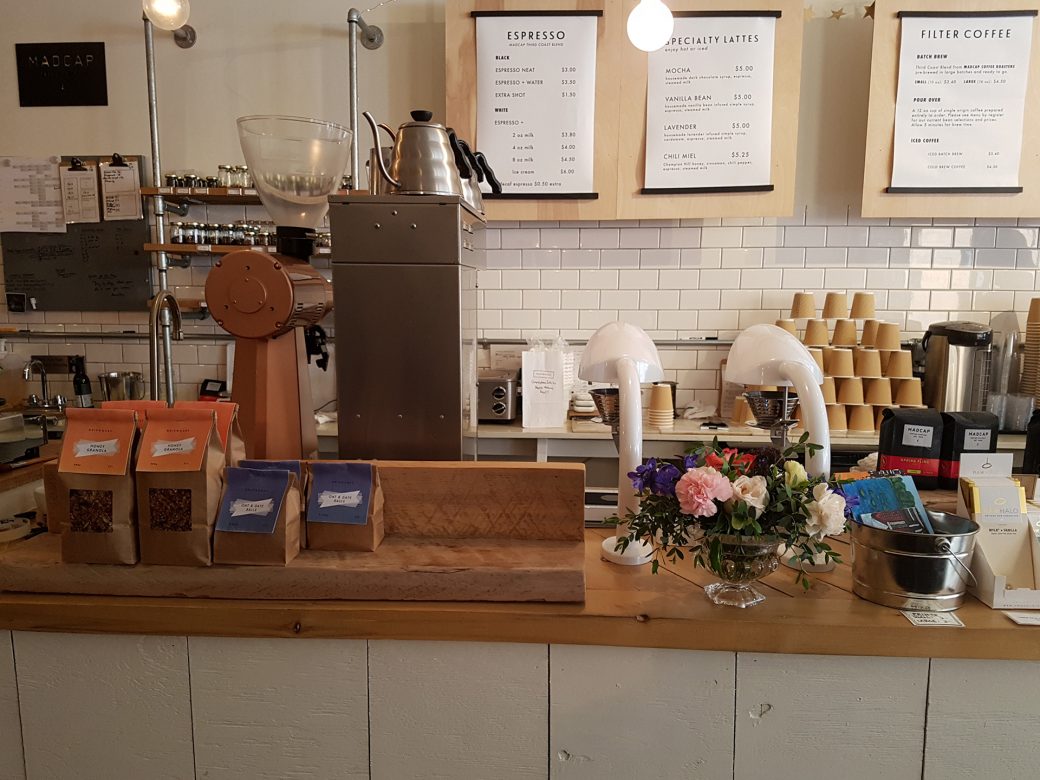
The cafe is set up galley-style, long and narrow with the bar on one side and booth seating on the other, with window seats and regular two-top tables toward the front. Lots of wooden furniture, white tile, and accents like metal cups and yellow stools give the space a farmhouse kitchen feel, which is echoed in the slate serving trays upon which sit a broad range of pastries—the blueberry pinwheel danish in particular comes highly recommended.

Coffee here is handled by a shiny white Slayer Steam, which pulls Madcap Coffee with the help of Mazzer and Mahlkönig grinders, while two Wilbur Curtis Seraphim brewers (also white) handle manual brewing, assisted by a Mahlkönig EK43. Coffee is not the only show in town, however, with a wide selection of loose leaf teas available, as well as the ever-popular matcha latte.

The fact that a coffee shop as polished and sophisticated as Dripworks can exist in a town as small as Petoskey is a testament to the work and dedication put in by the owners, as well as the changing tastes in this part of the country.

With all these cafe options in the area, it’s good to know that the next time you plan a vacation to the northern part of Michigan’s lower peninsula, you can do so safe in the knowledge that you’ll never be far from great coffee.

Dripworks Coffee is located at 207 Howard St, Petoskey. Visit their official website and follow them on Facebook, Twitter, and Instagram.

Fionn Pooler is a journalist based in Ann Arbor, Michigan, and the publisher of The Pourover. Read more Fionn Pooler on Sprudge.

The post The Coffee Lover’s Guide To Traverse City, Michigan appeared first on Sprudge.


from RSSMix.com Mix ID 8200593 http://sprudge.com/the-coffee-lovers-guide-to-traverse-city-michigan-133980.html

This Is How Much It Costs to Produce Coffee Across Latin America

Let’s say a filter coffee at your local specialty café costs US $4.00. But how much did the green coffee required to make it cost – both to buy and to produce?

The third wave is demanding fairer prices for better-quality coffee. However, without knowing how much farmers need to spend to produce a pound of coffee, and how that varies across countries and production methods, it’s hard to know what “sustainable prices” really are.

This is why Caravela Coffee, as part of its PECA or “coffee grower education” program, has recently published a report on the cost of production in six Latin American countries: Ecuador, Colombia, El Salvador, Guatemala, Nicaragua, and Peru. To find out exactly how much coffee really costs, I spoke to Luis Guillermo Cortes, the PECA Program Director.

You might also like Green Coffee Pricing Transparency Is Critical (And Complicated)

coffee plantationA view over a coffee plantation in Tarrazú, Costa Rica. Credit: Sunghee Tark

Understanding Coffee Costs

As Caravela Coffee’s report states, “the sustainability of the coffee industry starts by understanding costs of production and the variables that affect it.” Until we know this, sustainability is impossible.

Luis tells me that “the majority of coffee producers are not aware of how much it costs exactly to produce a kilogram of coffee.” This can leave them unable to effectively budget and allocate resources throughout the year, putting them in a vulnerable position.

Caravela Coffee’s aim is to build on this report by creating an app that will help farmers track their individual expenses and budget accordingly. But until then, at least we now know how much, on average, it costs to produce coffee in six countries – and what some of the biggest expenses are.

cost of productionCalculating the cost of production. Credit: Caravela Coffee

How Much Does This Data Tell Us?

In order to organize the data into a usable tool, Caravela Coffee made three key assumptions:

  1. The size of the farm was assumed to be three hectares with between 4,500 plants per hectare (Ecuador) and 5,500 plants per hectare (Colombia). Luis tells me that this is because “three hectares is what a family needs to survive; with one hectare of land, a family cannot survive.” It’s worth noting, however, that costs per hectare (or pound) will always decrease as farm size increases.
  1. Each farm was assumed to produce 25–30 bags of parchment coffee per hectare.
  1. Producers were assumed to have 15% of their planted hectares under renovation each year.

From here, Caravela Coffee calculated costs at a national level. Different farm structures and production methods mean that the costs cannot be completely accurate for every farm (this is where the app will help). Yet Luis says, “This study made the key assumptions in order to calculate what would be ideal to invest in a farm of a given size, so as to derive the best output.”

Of course, there are some things that will affect the model and that may fluctuate over time. Luis tells me, “The fluctuation of the exchange rate affects the producers when the payment per pound is made in dollars – which is what happens. For instance, in Colombia, one dollar used to be 3,000 pesos but it has gone down to 2,800 pesos. So, the total amount of money that the producer gets is directly affected.”

Additionally, other domestic changes can have an impact. For instance, Luis says, “In El Salvador, the minimum salary at the countryside level and the city level are now the same. So, the situation for the producer has changed.”

Caravela Coffee’s data is a useful starting point. However, it’s important that it continues to be updated and that everyone in the coffee industry – producer, trader, roaster, and more – remains aware of the impact of local changes.

With that in mind, it’s time to look at Caravela Coffee’s findings.

Results: How Costs Vary Across Countries

Let’s take a close look at how costs vary across the six countries:

Table 1: Total Cost (USD) – 3 Hectares:

Colombia Ecuador Nicaragua Peru Guatemala El Salvador
Administration 5,537 7,318 2,943 4,721 6,340 5,316
Harvest (labor) 5,690 6,750 3,870 5,769 5,068 4,875
Labor 950 1,683 1,316 1,292 2,118 265
Supplies 2,594 3,306 2,452 2,443 2,755 3,363
Infrastructure 778 668 2,186 332 783 979
Renovation 195 188 215 279 336 704
TOTAL 15,744 19,913 12,981 14,837 17,400 15,503


A quick note on labor: “Harvest (labor)” refers to payments made to seasonal coffee pickers, while “Labor” refers to general year-round labor. “Administration” also includes labor: it is the equivalent of one person hired at minimum wage for each country.

There are striking differences between the six countries. Ecuador has the highest total cost of production while Nicaragua has the lowest. The labor cost (harvest, administration and general labor combined) explains much of the variation in costs. However, it’s worth noting some discrepancies.

El Salvador, for example, spends the least on labor but allocates the most for renovation. Nicaragua has the lowest costs overall, especially in terms of labor, but allocates far more for infrastructure – something that is even more evident when we look at cost distribution by percentage.

This is because infrastructure includes the drying facilities. In Nicaragua, farmers generally pay by the pound for a mill to dry their coffee.

Table 2: Cost Distribution

Colombia Ecuador Nicaragua Peru Guatemala El Salvador
Administration 35% 37% 23% 32% 36% 34%
Harvest (labor) 36% 34% 30% 39% 29% 31%
Labor 6% 8% 10% 9% 12% 2%
Supplies 16% 17% 19% 16% 16% 22%
Infrastructure 5% 3% 17% 2% 5% 6%
Renovation 1% 1% 2% 2% 2% 5%
TOTAL 100% 100% 100% 100% 100% 100%


Given the data above, Caravela Coffee calculated the costs of production per pound of parchment coffee. But remember that this is the average cost of production for commodity coffee. Luis says that specialty coffee, such as what Caravela Coffee purchases, will typically cost more.

This is due to increased wages for pickers (which reflect the fact that selective picking is harder and more time-consuming), greater investment in wet milling and drying, and more.

Table 3: Costs (USD/lb)

Colombia Ecuador Nicaragua Peru Guatemala El Salvador
Administration 0.42 0.70 0.24 0.41 0.51 0.44
Harvest (labor) 0.43 0.65 0.31 0.50 0.41 0.40
Labor 0.07 0.16 0.11 0.11 0.17 0.02
Supplies 0.20 0.32 0.20 0.21 0.22 0.28
Infrastructure 0.06 0.06 0.18 0.03 0.06 0.08
Renovation 0.01 0.02 0.02 0.02 0.03 0.06
TOTAL 1.19 1.91 1.05 1.28 1.40 1.28


As we can see, there is a significant difference in the cost of production, even in countries that are geographically relatively close.

A Country-by-Country Guide to Production Costs

Above all, the data points to the need to treat each country individually. A “sustainable price” in Ecuador is not the same as a sustainable price in Nicaragua. The cost of supplies in El Salvador is different from in its neighbor, Guatemala.

So, what have we learned about each country?

Colombia: Around one-third of costs go on administration, and another third goes on harvest-time labor, meaning that labor shortages or changes to workers’ rights could have a significant impact here. Renovation costs are slightly lower than average.

Ecuador: Administration is Ecuador’s biggest cost, in a country where the cost of production is already high. (At US $1.91/lb, it is significantly higher than the international market price for commodity coffee of US 110.72¢, as of the 16th of July 2018.)

Nicaragua: One of the few countries where coffee production costs less than the international market rate (barely), administration is less expensive but infrastructure costs more. Supplies make up a larger percentage of the budget but, in real terms, are relatively inexpensive.

Peru: Harvest-time labor is this country’s biggest expense; out of all the countries surveyed, only Ecuador spends more on it in real terms – and at 40%, no other country dedicates such a large percentage of their budget to it.

Guatemala: Another relatively expensive country, Guatemala’s harvest-time labor makes up a lower percentage of their outgoings. However, the amount in real terms isn’t particularly low, compared to its neighbors.

El Salvador: A relatively cheap country in which to produce coffee, El Salvador still invests significant money in administration. Harvest-time labor costs are low, however, while renovation is relatively high.

Ripe-red coffeeRipe-red coffee cherries dry on a raised bed. Credit: Sunghee Tark

Breaking Down The Costs

But it’s not just enough to understand how much everything costs. We need to understand why and how this affects quality, profitability, and sustainability.

  • Labor Cost

Luis says, “In coffee, more than 70% of the total production cost goes towards labor costs.” And roughly 28% of this is actually administrative labor costs.

This means that the cost of labor is directly linked to the profitability of a Latin American coffee farm. And often this factor is outside of producers’ control.

Luis says, “In Ecuador, labor is a lot more expensive than in Nicaragua due to the lower minimum wage in Nicaragua.” And in Colombia? “The cost of labor is high due to the higher cost of legal fees and insurance.”

Luis also tells me, “In the past five years or so, the labor cost has increased quite a lot.” This is because younger generations are generally less interested in working on farms, instead seeking more profitable work in the city. In turn, this has helped fuel a labor shortage and driven up costs.

Graph of Cost StructureGraph of Cost Structure for Labor Cost in 6 Different Countries. Labor cost directly related to harvest comprises almost 50% of the total cost of production for a coffee farm, while labor and administrator cost combined can add up to 80% of the total cost of production. Credit: Caravela Coffee

  • Renovation and Fertilization

With labor making up almost 70% of total cost, producers are left with just 30% of their budget to do everything else on the farm. Luis says that this “is split among other expenses, such as the fertilizers, costs of combating plant disease, utility costs, transportation, etc.”

But this can have a troubling knock-on effect. Luis explains, “This means that if the price of coffee goes down, the producers will stop fertilizing.” With such a small amount of their budget dedicated to it, there is little flexibility for cutting costs. Yet they cannot prioritize fertilizer over the wages they have to pay seasonal workers or, say, providing food for their own family.

“This imposes a great risk for the following year,” Luis stresses. Reduced fertilization will reduce productivity, which will mean less money earned. In turn, this will mean even less money for fertilizer.

Breakdown of cost structureBreakdown of cost structure for each country. Labor and administration costs represent the largest expenses, while the remainder of the budget is split between renovation, equipment, supplies, and other indirect costs. Credit: Caravela Coffee

Profit and Cost Margins: Bleak News for Producers

Luis tells me that, once producers know their costs, they can estimate their profit and cost margin using this equation:

Profit Margin = Sales Revenue – Costs of Production   X 100 

            Costs of Production

(This is also explained in more detail in a Caravela Coffee blog post, while in another blog the company gives advice for tracking and recording these costs.)

The price of coffee fluctuates over time, making it hard to calculate the exact profit margin for each country. However, on June 11th, 2018, the international market price (the C price) closed at US 117.10¢ per pound.

In Ecuador, where the cost of production is US $1.91/lb, a farmer paid the C price would make a loss of -38.7%. Nicaragua has a slightly lower production cost of US $1.05/lb, leading to a profit margin of 11.4%. Peru would have a profit margin of -8.6%, Guatemala -16.4%, Colombia -1.7%, and El Salvador -8.6%.

In other words, most countries cannot profit when only paid the market price. And Luis is of the opinion that farms require a minimum of a 30% profit margin to survive and pay for basic things such as education, food, and healthcare.

When Caravela Coffee compared the market price to the costs of production in 2017, they noticed a serious deficit for both one- and three-hectare farms. The market price is lower than what it costs to produce coffee in nearly all of these six countries, threatening the sustainability of the industry.

international coffee priceThe cost of production for 3- and 1-hectare farms, compared with the international coffee price. Credit: Caravela Coffee

What Does This Data Mean for You?

Whether you’re a producer, roaster, barista, or consumer, this study is relevant.

  • Producers…

With the app that Caravela Coffee is designing, you’ll be able to record your costs more easily. Luis says that this was designed to help you manage your farm in terms of budgeting and resource allocation. As you’re paid just one to three times a year, you know how critical this is for ensuring a successful harvest the following year.

What’s more, it will help you evaluate your farm’s performance. In turn, you can allocate resources to the most profitable areas, resulting in increased productivity and profitability overall.

Lastly, the study gives insights into how much you should be selling your coffee for in order to operate sustainably.

wet millA laborer works in a wet mill, measuring how many cherries were picked that day. Credit: Sunghee Tark

  • Roasters, Buyers, & Consumers…

This study affects you, too. Luis says, “Now we have an idea of what it costs for a producer to produce coffee per three hectares… The industry can decide, then, how much we can pay for the work done on the farms.”

He recommends that if “it costs US $15,000 on a three-hectare coffee farm in Colombia, the producers will need to receive at least US $20,000 for the coffee they produce in order to sustain them and their family.” (This, of course, is for commodity coffee. Specialty coffee buyers should take higher costs into account.)

Additionally, Luis highlights that buyers need to understand the importance of having the right resources available at the right time. We’ve seen how resources can understandably be a producer’s last priority when funds are low – and we know that this is risky.

“If the producer doesn’t control certain diseases or pests at the beginning of the production period, say the coffee borer beetle, their crops will be severely affected for rest of the production period,” Luis stresses.

Using this study, he continues, “the market can investigate and consider how they can promote resources for the producers, given the cost, to help them invest more in their farms.” In turn, this will lead to increased productivity – something that benefits the entire industry.

“If you ask any farmer in Latin America if they are saving up for retirement, no one will say yes,” Luis says. “Because the money made from coffee isn’t enough for them. This cost needs to be added to the total cost of production, so that people can prepare.”

He believes that “the change toward a sustainable chain within the industry needs to start from the coffee shop… There’s an inequity. Where does the largest portion of the money generated from coffee get retained? It never comes back to the producers.”

So, what can we, as a part of the coffee industry, do today to ensure coffee’s sustainability? How can we collaborate?

I think we all know the answer.

Written by Sunghee Tark. All quotes translated from Spanish by the author.

Please note: This article has been sponsored by Caravela Coffee.  

Want to read more articles like this? Sign up for our newsletter!

The post This Is How Much It Costs to Produce Coffee Across Latin America appeared first on Perfect Daily Grind.


from RSSMix.com Mix ID 8200593 https://www.perfectdailygrind.com/2018/07/this-is-how-much-it-costs-to-produce-coffee-across-latin-america/