Monday, January 29, 2018

Un Mercado Volátil: La Economía de los Precios del Café en el Mundo

“¿Por qué el precio que nos pagan, cambia?”

Estaba frente a 50 agricultores en una escuela de educación primaria y secundaria, con un sólo salón y sin aire acondicionado, en el municipio de El Espinal, departamento de Tolima, Colombia. Había estado explicándoles cómo hacer buen uso de las cadenas de suministro internacionales para  alcanzar los mercados extranjeros  lucrativos, pero esa pregunta me impactó.

La mujer que preguntó ha dependido toda su vida de este sistema de precios, pero nadie antes le había explicadocómo funciona el mismo. No había pensado en explicarlo porque no imaginaba que existiera semejante brecha de información. Pero la brecha existe, y no solo en las fincas de América Latina.

English Version:  An Unstable Market: The Economics of Global Coffee Prices

Mientras todos transpiraban y mi amigo apuntaba hacia su reloj, le pedí al pasante unos marcadores de pizarra y me lancé a realizar una clase espontánea de microeconomía. Durante las siguientes horas exploramos las curvas de la oferta y la demanda y la elasticidad del precio. Una docena de agricultores se involucraron apasionadamente en esta conversación.   

Esto es algo que tanto los agricultores, importadores / exportadores, como los consumidores necesitan saber. 25 millones de pequeños agricultores se vuelven vulnerables por las fluctuaciones en el mercado del café, y es nuestra responsabilidad, como consumidores éticos, tener esto en cuenta cuando compramos nuestras bebidas.

Echemos un vistazo a los tres factores que afectan el precio global del café.

VER TAMBIÉN: Diversificación en la Producción de Café de Especialidad: El Caso Agrícola y Económico

Pizarra con precios del caféLos precios del café en el mundo: más complejo que las variedades, peso y catación. Crédito: Joanna Bourne a través de Flickr.

1. Precio C y el Mercado ICE

Al igual que las acciones, y cualquier otro producto, el precio del café cambia minuto a minuto. Este es definido por las bolsas de comercio, incluyendo la  Intercontinental Exchange (ICE) de Nueva York, la cual es la más importante para el café Arábica y la que establece lo que llamamos el Precio C.  Y, como cualquier otro producto básico negociado en la bolsa, como acciones, bonos, divisas, etc., este Precio C se define por la oferta y la demanda.

Si hay poco café disponible, el precio subirá hasta el punto en que la oferta iguale a la demanda. Esto quiere decir, que, algunas personas interesadas en comprar café decidirán no hacerlo conforme incrementen los precios. Por tanto, el precio dejará de aumentar cuando las personas restantes, que sí puedan pagar, absorban la totalidad de la oferta disponible.

Por otro lado, si hay mucho café disponible, el precio bajará, incrementando así la demanda y asegurando la venta total del mismo. En otras palabras, aunque haya más café disponible que personas interesadas en comprarlo, a medida que el precio baje, una mayor cantidad de personas querrá aprovechar el negocio. Por lo que el precio dejará de bajar cuando las personas acuerden comprar exactamente la cantidad ofrecida.

Esta tendencia a que la demanda cambie a medida que los precios cambian se llama Elasticidad Precio de la Demanda (EPD), y es la sensibilidad de precio única del mercado.

Paisaje cafeteroAtardecer en la cima de la cordillera occidental de Colombia, más de 2000 m.s.n.m. El futuro de los agricultores depende de las fluctuaciones en el mercado del café.

2. Derivados a Base de Café

A la complejidad se suman los instrumentos de cobertura, como los contratos de futuros, que son promesas de compra para una fecha futura a un precio determinado de hoy. ¿Suena fácil? Está a punto de ser un poco más confuso.

El precio acordado se basa en un precio fijo, basado en la oferta y la demanda, que se mantiene hasta la fecha de entrega, cuando el contrato expira. Producto del mercado de derivados, la oferta y la demanda previstas para el café están contenidas dentro del precio C.

Por ejemplo, si las personas creen que el Precio C incrementará en el futuro por las condiciones de la oferta y la demanda, como por ejemplo una cosecha débil en Brasil, hoy, ellos empezarían a comprar contratos de futuros para vender y así obtener una ganancia en caso el precio se incrementara al acercarse la fecha de entrega. Este aumento en la demanda de contratos de café causaría que el precio actual suba.

También puede ocurrir lo contrario. Si se especula que el precio bajará, las personas comenzarán a vender el café y sus contratos de futuros, o bien, comprarán posiciones cortas. Esta disminución de la demanda hará que el precio actual baje en función de la especulación futura.

Granos de cafe¿Cuánto valen estos granos? Ese es un cálculo complejo. Crédito: Isai Symens vía Wikipedia.

3. Cobertura & Apuesta

Los derivados del café se usan como cobertura financiera por los actores de la industria y como una inversión por los especuladores ¿Qué significa esto? Bueno, una “cobertura”, como actor en la industria del café es comprar un producto financiero basado en el precio que tendrá el café en algún punto en el futuro. Esto se hace para protegerte de algún cambio en el precio antes del pago, entrega o cosecha. La cobertura es un elemento importante de la economía moderna y permite que la industria de productos básicos funcione.

Por ejemplo, un importador de café verde hace un trato con un exportador en un país productor, para comprar 17 toneladas de café verde al precio C + 10 centavos por libra. Ese café no se entregará sino hasta los 3 meses, por lo que si el precio C aumenta entre hoy y la fecha de entrega, el importador debe más.

Demos una mirada a cómo funciona en la práctica. Este importador adquiere un contrato futuro por un plazo de tres meses para básicamente asegurar el precio de hoy. Si el precio C aumenta en el intervalo de los 3 meses, el importador compra el café a un precio más alto y vende su contrato futuro para obtener ganancias, compensando así lo que invirtió demás en el café. Por otro lado, si el precio C baja, el importador compra el café más barato de lo esperado y vende su contrato futuro a pérdida. En ambos casos, este obtendrá el café al precio del día que pactó en el contrato.

La compra de este instrumento de cobertura es un indicador de la demanda real de café y, por lo tanto, contribuye al movimiento lógico del precio C basado en la verdadera oferta y demanda.

Sin embargo, cualquiera puede comprar instrumentos financieros basados en el precio C, no solo aquellos involucrados en el comercio físico. La especulación sin el deseo de comprar o vender café en físico, que representa cerca del 90% de los contratos de futuros transados, también  contribuye a la fluctuación del precio C que está basado en la oferta y la demanda de futuros. El gran volumen de futuros negociados puede causar apatía de precios u oscilaciones  que normalmente no ocurrirían en un mercado basado puramente en el producto físico.

¿Suena bastante inestable todavía?

Zona cafeteraLa luz del sol sale a través de las nubes lluviosas y brilla en una finca de café en el Eje Cafetero colombiano.

Como mercado financiero, esto es parte del juego. Sin embargo, en la práctica, hay dos defectos en este sistema. El primero es que, si bien la industria puede cubrir la volatilidad del mercado a un nivel aceptable de riesgo, la mayoría de los 25 millones de pequeños agricultores que producen el 80% del café en el mundo, no tienen esa capacidad. Esto deja a los agricultores muy vulnerables a las fluctuaciones de precios y son los que menos pueden soportarlas. El segundo es que, no hay una consideración formal para el café de calidad de especialidad, pero ese es un gran tema que merece su propio artículo.

El mercado del café siempre ha experimentado auges y caídas, ha sido susceptible al mal tiempo, a las plagas y a los conflictos civiles. La forma en que se compra el café solo termina agregando más volatilidad al mismo.

VER TAMBIÉN: Diversificación en la Producción de Café de Especialidad: El Caso Agrícola y Económico

Escrito por K. Wienhold, fundador de Direct Origin Trading, con agradecimiento a Fulanito Gonzales por su aporte.

Traducido por Alejandra M. Hernández y editado por Ricardo Gallopp R.

¿Quieres Seguir Leyendo Artículos Como Este? ¡Suscríbete Aquí!

The post Un Mercado Volátil: La Economía de los Precios del Café en el Mundo appeared first on Perfect Daily Grind.


from RSSMix.com Mix ID 8200593 https://www.perfectdailygrind.com/2018/01/un-mercado-volatil-la-economia-de-los-precios-del-cafe-en-el-mundo/

Barista Basics: How to Make an Espresso in 14 Steps

Espresso: roughly 30 ml of coffee goodness. An amazing espresso can be complex, full-bodied, and sweet. It can be the best thing about your day.

And an espresso isn’t just a beverage in its own right – it’s also the heart of many customers’ favourite drinks, such as the latte, cappuccino, Americano, flat white, cortado, macchiato, and more…

In other words, learning how to pull a great espresso shot may be one of the most important things you learn as a barista. And as someone who spends my days coaching baristas, whether for employment or coffee championships, I’m here to talk you through how to do it.

A word of warning: making a great espresso requires dedication, attention to detail, and consistency. But the effort is always worth it. So, let’s get started!

Looking for more advanced instructions? Check out a barista’s guide to Perfecting Your Espresso Shots!

EspressoThe final moments of pulling an espresso shot. Credit: Paul Mordheweyk

The Basic Parameters of an Espresso

When making any coffee beverage, you need to know the dose of dry coffee grounds, the amount of water, the extraction time, and the final volume. All these factors are related – and, with espresso, you can actually ignore the water volume for now.

Let’s break it down:

  • The amount of dry coffee grounds will vary depending on your espresso basket, but you’ll probably be using 8–10 grams per single dose.
  • A single espresso shot is generally 25–35 ml, which should easily be achievable with these parameters.

However, remember that these are flexible guidelines, not hard-and-fast rules. Every coffee is different. Some will taste better with a shorter extraction time, others with a slightly longer one. Roast profile and grind size will also affect the best parameters.

Learn more! Discover the differences between espresso & ristretto!

While you learn how to make an espresso, use these guidelines as a base – but as you advance in your coffee knowledge, don’t be afraid to experiment. Remember: taste is key. That moment when you drink the espresso is when you know if you’ve pulled a great shot. These parameters will help you to do so, but they’re not the criteria by which customers will judge their drink.

And now you have your parameters, it’s time to begin.

Espresso and baristaEspresso ready to be enjoyed. Credit: Nate Dumalo

Step 1: The Cup

It’s important to warm the cup before using it. Rinse it with hot water so that the porcelain or glass won’t cool down your beverage on impact.

Step 2: The Portafilter & Basket

Next, check your portafilter handle to ensure it’s clean and dry. Remember, old coffee residue will affect the taste of the new espresso you’re making. A wet basket will affect extraction, as it will make the coffee moist.

Step 3: Grind & Dose

Dose your ground coffee into your portafilter. Pay attention to the grind size as well as the dose to make sure you don’t over- or under-extract your shot. (Remember: under-extracted coffee will taste sour; over-extracted coffee will be bitter.) If you have a calibrated on-demand grinder, then it’s easy to check the dose. If not, it’s best to use a scale.

PortafilterDosing ground coffee into the portafilter. Credit: Paul Mordheweyk

Step 4: Distribute Grounds

Tap the portafilter handle gently on the tamp mat to distribute the ground coffee evenly, or – if you have one – use a distribution tool. This is a very important step, as it will ensure that you don’t have any air pockets in the coffee. The presence of air pockets means water will channel, i.e. it will take specific routes through the ground coffee rather than spreading evenly. In turn, this means that some grounds will extract more than others.

Find out more about coffee distribution in our video guide!

TamperUsing a distribution tool to avoid air pockets. Credit: Onnivian Yuan Yana

Step 5: Tamp

The next step is to tamp. Again, the aim is to remove any air pockets and ensure the coffee is completely level.

Take your tamper and press it down onto the ground coffee, making sure you both tamp straight and use sufficient pressure. The pressure is important as this will ensure the coffee is adequately compressed and that the puck will retain its shape. (However, you probably don’t need 30 lb of pressure, despite the popular myth.) Similarly, a straight tamp will make sure that the coffee is even. In this way, it will help you avoid channelling and, in turn, over, under, or inconsistent extraction.

Learn more! Check out our video guide to tamping!

Tamping coffeeTamping before pulling an espresso shot. Credit: Angga Adi

Step 6: Polish

Finally, using the tamper, polish the surface of the ground coffee. To do this, place the tamper on top of the puck and spin. This will smooth out any small ridges, ensuring the surface of the coffee really is smooth and flat.

Step 7: Clean

Can you imagine ordering a cappuccino and finding coffee grounds in it? To avoid this ever happening, make sure to clean any excess dry coffee off the top, ears, and spouts of your portafilter.

Coffee groundsA ripple tamper has left concentric circles in the ground coffee. Credit: Paul Mordheweyk

Step 8: Rinse

Rinse the group head before inserting the portafilter (brush the group head if you need to). This will remove any old coffee particles from the shower head. Be careful not to overlook this step! If any of those particles did make it into your espresso, you could expect it to taste inconsistent or stale.

Step 9: Pull The Espresso

Finally, you’re ready to insert the portafilter handle into the group head and start brewing your espresso! Make sure to begin brewing immediately, otherwise the heat might cause the surface of the coffee to burn.

EspressoA well-brewed espresso flows smoothly into a waiting cup. Credit: Paul Mordheweyk

Step 10: Serve

Once the machine stops – either automatically or because you’ve manually stopped it at 25 seconds – remove the cup from the machine tray. You can now either serve the espresso or start steaming milk for a latte or cappuccino.

Espresso machineA freshly brewed espresso, ready for serving. Credit: Methodical Coffee

Step 11: Discard The Puck

Remove the portafilter and knock the coffee puck out into the knock box. Remember to never skip this step!

Step 12: Clean The Handle

Clean and rinse your handle ready for the next shot. Don’t forget to dry it, either!

Step 13: Clean The Group Head

Rinse and brush the group head. You need to clean it thoroughly to remove any oils or particles that could spoil the next shot.

Step 14: Replace Equipment

Put the portafilter back into the group head, ready for the next round. This will keep it clean and hot, and also prevent it from getting lost!

Shot of espressoServing up a freshly brewed espresso. Credit: Claudio Alejandro

So, there you have it: the 14 steps to pulling a great espresso! This is a basic set of instructions but it’s important that you never overlook the foundations of good brewing.

With time and experience – and let’s not forget the fancy barista tools – your steps may change. They will become more advanced, evolving with you as a barista. There is always more to learn in this industry (which is what makes it so fun!) However, if you begin with this process, you’re off to a very good start.

Written by Shaun Aupiais.

Perfect Daily Grind

Want to read more articles like this? Sign up for our newsletter!

The post Barista Basics: How to Make an Espresso in 14 Steps appeared first on Perfect Daily Grind.


from RSSMix.com Mix ID 8200593 https://www.perfectdailygrind.com/2018/01/barista-basics-how-make-espresso-14-steps/

Friday, January 26, 2018

ReAnimator Celebrates Philly’s Super Bowl Berth With The Foles-gers Blend

Warning: Sports talk ahead. If that doesn’t suit you, please enjoy this article about the Puppy Bowl.

With every fiber of my being, I hate the Philadelphia Eagles. Not just because I was born and raised in Dallas, a lifelong fan of (feckless since the early 90s) Cowboys, but because I can spot pure sports evil when I see it. And that is what the Eagles—more specifically, their fans—are: pure sports evil. The city of Philadelphia had to grease all the light poles ahead of the NFC Championship game on the mere chance of an Eagles win and the resultant riots. They booed Santa Claus. Who does that? They are so evil in fact, that they have forced me into a position I thought impossible; I’m rooting for the New England Patriots, smug Tom Brady, Cheatin’ Bill Belichick, and all. These are truly the worst of times.

But if there’s one thing that always cheers me up, it’s puns. So you can but imagine the complicated emotions I feel about the new Foles-gers limited edition blend from Philadelphia’s ReAnimator Coffee.

It’s a great pun. Named after the Best Part of Waking Up and the Eagles starting née back-up née starting quarterback Nick Foles, the good folks at ReAnimator decided to take a break from whipping batteries at each other—the national pastime of Philadelphia—to celebrate being chosen as the sacrificial lamb to be laid at the feet of Trump-loving Tom and the rest of the Funky Bunch. The blend of unknown origins has tasting notes of “brown sugar, almond, [and] victory;” the whole thing makes me sick.

But if there’s a silver lining—a crack in this liberty bullshit, a 3am Wawa hotdog after a night of pounding Lagers—it’s that all the proceeds go to the Fund For The School District of Philadelphia.

The Fole-gers blend from ReAnimator costs $19, so go buy a bag and support a good cause. And go Patriots I guess. I feel ill.

Zac Cadwalader is the news editor at Sprudge Media Network and a staff writer based in Dallas. Read more Zac Cadwalader on Sprudge.

*top image via ReAnimator Coffee

The post ReAnimator Celebrates Philly’s Super Bowl Berth With The Foles-gers Blend appeared first on Sprudge.


from RSSMix.com Mix ID 8200593 http://sprudge.com/reanimator-celebrates-phillys-super-bowl-berth-with-the-foles-gers-blend-130011.html

Coffee Design: Ferris Coffee & Nut Co. In Grand Rapids, Michigan

Who doesn’t enjoy a refresh every now and then? A remodel, an upgrade, a new hair color—there’s something magical about shaking things up. At ninety-four years old, Ferris Coffee & Nut Co. decided to do just that with their line of coffee offerings. Each selection has a distinct design, created in-house. We asked Mark VanTongeren, head of Business Development, to tell us more.

Tell us a little bit about your company.

Ferris Coffee & Nut Co. is a family-owned and operated specialty roaster that produces coffee, nuts, and trail mixes with care and quality at every stage. Located in Grand Rapids, Michigan since 1924, our organization has witnessed many changes to the region, the industry, and to customer preferences and needs—this has ultimately lead to our own significant organizational and cultural change over the past five years. With that said, our mission to build relationships that thrive through our products has endured and allowed us to continue serving our customers. From partnering with producers to ethically sourcing products in a way that values and promotes the growers and farmers, to roasting and serving our products while highlighting quality and care, our holistic approach to business is not transactional, but relational at heart.

As our company has grown and changed over the years, we’ve had the privilege of serving a wide variety of customers ranging from mom-and-pop coffee shops to national food distributors, churches, workplaces, restaurants, and industry-leading breweries. Every one of our customers is unique, and every customer requires personalized service.

This personalized approach requires much more than simply producing and delivering a great product: we specialize in state-of-the-art coffee education, equipment service and repair, and business consulting services to provide our customers with the support they need to be successful.

Each package has its own distinct design. What’s the process of deciding what’ll go on each offering?

Our process always starts by meeting with our Director of Coffee, Sam Mirto, to hear his stories from his sourcing trips. He tells us about the people behind the coffee, the farms and mills he visited, and oftentimes small details he experienced that might not be directly related to the coffee, but are still worth sharing—like the time when he could hear wild baboons howling right outside of his cabin at night. Through learning about his unique experiences and perspective, it drives and inspires the design decisions behind each coffee identity. Take Ethiopia YirgZ, for example—a coffee that is hand-sorted three times with great detail. The fingerprint pattern was created to reflect that, but also to feel like a topographical map, that represents the high altitude at which this coffee is grown. The colors in this label are inspired by the Ethiopian flag, but softened and subdued. It is important to us that the design reflects our direct interactions with these people and places, because that’s what makes each coffee and relationship unique to Ferris.

Who designs the labels?

Our in-house design team—Ursula, Lisa, and Kacie. Once the three of us have met with Sam to hear and document his personal experiences, we’ll usually each pick one coffee (or more, depending on how many new offerings are coming in) and start creating the artwork, based off of our collective notes about whichever coffee we chose.

Why are aesthetics important?

There were no visual elements differentiating the nuances of each coffee in our previously designed system, let alone the stories behind them. As we coffee people all know, no two coffees are alike, so grouping them together into categories in that way can only say so much. Each coffee has its own personality and we feel strongly compelled to communicate them to our customers through our packaging. As our coffee program continues to grow, we identified this as a great solution looking forward. By using the bag itself as the vehicle, the star of the show becomes the unique labels and the coffee inside. Storytelling is a focus of ours and finding ways to communicate these stories with our customers is always on our minds- Consciously or subconsciously.

Where is it currently available?

Select grocery and specialty stores, our wholesale partners, in our own shops, and on our website.

Company: Ferris Coffee & Nut Co.
Location: Grand Rapids, Michigan
Country: United States
Design Date: August 2017
Designer: Ferris Coffee & Nut Co.

Zachary Carlsen is a co-founder and editor at Sprudge Media Network. Read more Zachary Carlsen on Sprudge.

The post Coffee Design: Ferris Coffee & Nut Co. In Grand Rapids, Michigan appeared first on Sprudge.


from RSSMix.com Mix ID 8200593 http://sprudge.com/coffee-design-ferris-coffee-nut-co-in-grand-rapids-michigan-129939.html

Lessons You Learn When Launching a Coffee Shop

Maybe you always wanted to run a coffee shop. Or maybe – like me – you had that moment of epiphany, sipping on a brew in your favorite café and realizing exactly what you wanted to do with your life. But how you turn that dream into reality?

Well, I don’t have all the answers, but I learned a lot of lessons when I opened up my very own specialty coffee shop. And along the way, I ended up with a whole new coffee community. Let me share my story with you, so that they can help you on your journey.

You might also like Coffee Shop Financing Made Simple!

Coffee and snacksCoffee and snacks served at Chapter Coffee Roastery & Café. Credit: Chapter Coffee Roastery & Café

Chapter One: The Start-Up Project

Just like any other newbie trying to start a business, I didn’t understand what I was getting myself into. All I knew was that I was in love with the idea of owning a coffee shop. My love for coffee, my passion for teaching, and my personal mission of wanting to serve something I’d made myself – they drove me to open Chapter Coffee Roastery & Café.

When we opened, the mood was electric. Customers flocked in and I was delighted to see people enjoying quality food and beverages.

Yet I still didn’t have any inkling of the challenges that awaited me. Reality struck only when I discovered the realities of employee management, the need to sustain the momentum of customers coming in, the difficulties in ensuring the shop brand is well received, and more. I learned that I would need to spend time away from the coffee bar, not just behind it.

And so I started studying.

Read more about this! Check out: How to Improve Coffee Shop Profitability & Reduce Risk

Lessons Learned:

1. As a coffee shop owner, you’ll face many challenges. Remain focused and deal with them head-on.

2. Prepare for operational challenges: remember that opening a coffee shop is about more than just serving coffee

3. Try to deal with one problem at a time – and remember that they’re all different.

Don’t forget: these challenges make you a better business owner and decision-maker.

coffee CommunityThe construction phase of Chapter Coffee Roastery & Café. Credit: Chapter Coffee Roastery & Café

Chapter 2: Creating Awareness

I knew that we were serving quality food and beverages, but I also needed to create an awareness of the third wave and what we were doing as a coffee shop.

With this in mind, I turned to my first love: teaching. Soon, we started to conduct barista training classes, coffee cupping sessions for the public, and more. This gave me a sense of fulfillment. It made me realize there’s a real connection between serving coffee and imparting knowledge to the customers about the beverage they ordered.

Now, our baristas always take the time to introduce the coffee they’re serving to guests, especially first-time visitors. It’s become a trademark of ours.

And along the way, I listened to our baristas’ feedback. What worked for them? What worked for their customers? And just as importantly, what did they see that wasn’t working?

It didn’t take long before we saw our efforts translate into sales. When customers started pouring in, we realized that we were achieving our mission: propagating coffee knowledge and artistry in the Philippines. It was a wonderful moment.

You might also like: The Best Way to Introduce Customers to Specialty – Proven by Science!

Lessons Learned

1. Remember your goal – in my case, coffee education – and work out the best way to achieve it. Don’t be afraid to break the “rules” and have your own trademark, if it matches your vision for your coffee shop.

2. Find ways to connect with your customers – and help them connect to coffee.

3. Pay attention to your personnel, on both a professional and personal level. No matter the size, a company’s biggest asset is its people. Since we started small, our staff have experienced both the struggle and the glory of our journey. I can easily say that, without them, this journey would have been harder. Can you imagine how seamless our operations would be if our employees were motivated every single hour of every single day?

 Read more! How to Keep Your Best Baristas From Quitting

Coffee trainerErnest Martin leads a sensory skills and coffee cupping session for customers. Credit: Mark Philip Chua

Chapter 3: Gaining Regulars

It’s rewarding to see new people coming into our coffee shop. But it’s even more gratifying to see people coming back, not only for the food and drinks but also for the conversations and atmosphere.

Read more! How Can You Get Repeat Customers?

It starts with constant smiles and greetings, and grows with chats about coffee and the exchange of jokes. Before you know it, your regular seat-warmers have become your friends – and what better way to help people learn about drinking coffee than by doing it as a friend? The only hard part about it is that, when they finally learn, they become harder to please!

The coffee bar is a much better place now that we have people debating which origin is better, what the ideal water temperature should be, and which brewer should be used for different kinds of single origin coffees.

And now we’re taking our friendships beyond the café: as a group, we make coffee shop visits or “coffee crawls,” locally and internationally. In my recent travels, sightseeing has taken a backseat while coffee tourism with these customer-turned-friends has become the aim.

These coffee folks come from different walks of life – they are often industry leaders in their own right – and they have been part of my journey as mentors, as inspirations, and friends.

Lessons Learned:

1. There are few things more valuable than your regulars.

2. Don’t underestimate the importance of friendly baristas.

3. See your regulars as people, not customers, to build a community in your coffee shop. This community will enrich your life as well as helping to keep the coffee shop running.

BaristasErnest Martin, Johnny Tamayo, Mikael Daez, Mark Chua (left to right, back) Megan Young, and Janica Madridejos (left to right, front) tour Hong Kong in a coffee crawl organised by Chapter Coffee Roastery & Café. Credit: Chapter Coffee Roastery & Café

As of today, my coffee shop regulars have become my coffee community. We enjoy each other’s company over a cup of coffee and we try to share a cup together wherever we are in the world. And I hope they’ll continue to be there as my coffee shop grows and I learn even more.

It’s truly exciting what coffee can throw at you, be it the challenges or the successes. So why not sip on a bittersweet espresso and start planning your coffee journey?

Want to open your own café? Check out Coffee Shop Financing Made Simple

Written by Ernest R. Martin of Chapter Coffee Roastery & Café.

Perfect Daily Grind

Want to read more articles like this? Sign up for our newsletter!

The post Lessons You Learn When Launching a Coffee Shop appeared first on Perfect Daily Grind.


from RSSMix.com Mix ID 8200593 https://www.perfectdailygrind.com/2018/01/lessons-learn-launching-coffee-shop/

Thursday, January 25, 2018

La Marzocco Pledges $750,000 To The UC Davis Coffee Center

Now would be a good time to open a coffee research center. Today, espresso machine company La Marzocco announced they will be donating $750,000 to the University of California, Davis Coffee Center. According to a press release, the 750K pledge “represents the largest gift to date to the UC Davis Coffee Center.”

In 2017, both Peet’s Coffee and Curtis donated $250,000 to the UC Davis Coffee Center, but in 2018, La Marzocco is turning up the heat. The money will go toward building the first post-harvest coffee research facility in the United States.

From the press release:

“The forward motion of the coffee industry has always been the core of our mission at La Marzocco,” shares Kent Bakke, International CEO, La Marzocco. “We believe the Coffee Center at UC Davis represents a renewed focus on understanding the science behind coffee that will lead us to better practices for growers, importers, roasters and cafes. Our international team is expanding our research and educational initiatives and we hope UC Davis can be a partner in this effort.”

Also included the planned repurposing of the 6,000-square-foot building now dedicated to coffee academics will be the La Marzocco Brewing and Espresso Laboratory, which will of course include a litany of La Marzocco espresso machines.

For more information on the pledge, read the full press release here. And if there’s some sort of philanthropic arms race brewing, I want to be caught in the middle. I’ve got a great cause of your choosing that is in desperate need of six figures.

Zac Cadwalader is the news editor at Sprudge Media Network and a staff writer based in Dallas. Read more Zac Cadwalader on Sprudge.

*top image via UC Davis

La Marzocco is an advertising partner on the Sprudge Media Network.

The post La Marzocco Pledges $750,000 To The UC Davis Coffee Center appeared first on Sprudge.


from RSSMix.com Mix ID 8200593 http://sprudge.com/la-marzocco-pledges-750000-uc-davis-coffee-center-129933.html

The Monk Of Mokha: An Interview With Dave Eggers And Mokhtar Alkhanshali

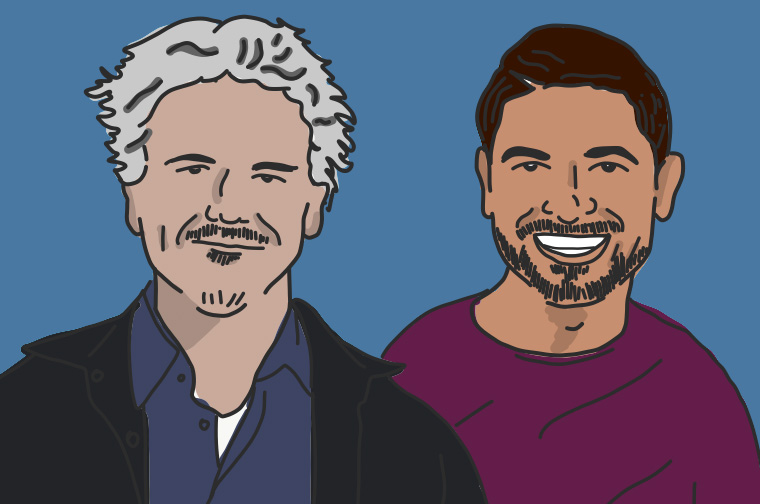
Illustration of Dave Eggers (left) and Mokhtar Alkhanshali (right)

On January 30th, 2018 the new book from noted author, novelist, and McSweeney’s founder Dave Eggers will be released through Alfred A. Knopf, a division of Penguin Random House. Titled The Monk of Mokha, it’s 300+ pages that tell the story of Mokhtar Alkhanshali, Yemeni-American coffee professional and founder of the coffee company Port of Mokha. The book chronicles his journey from working in an apartment lobby in San Francisco to becoming one of his generation’s most important coffee professionals, braving war and personal hardship to help redefine the coffees of Yemen to a new generation of coffee lovers.

The reviews are in and they’re sterling. As with any new Eggers work, Monk of Mokha has been featured this week in publications ranging from The New York Times to The Guardian to the Los Angeles Times, who calls Monk of Mokha “a Horatio Alger story for the 21st century.” A flotilla of events are scheduled for the book’s release, starting tonight in San Francisco, where Eggers and Alkhanshali are appearing at the Nourse Theater as part of the City Arts lecture series. The fun continues across the Bay Area during the Monk of Mokha mobile book tour, in partnership with the San Francisco Public Library system, who have loaned out a bookmobile (converted into the “Mokha mobile”) for events across the region.
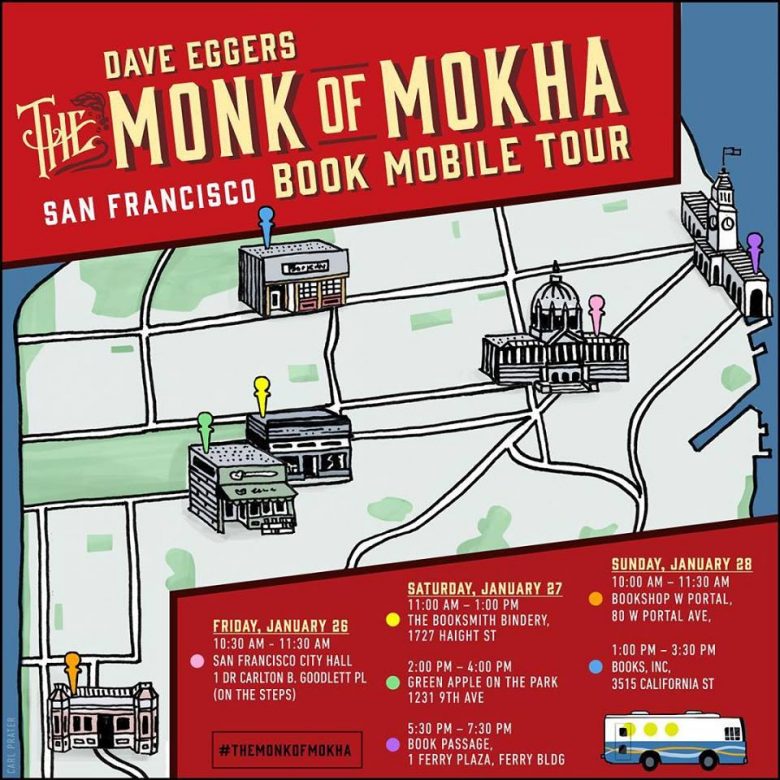
From there a speaking tour with Eggers and Alkhanshali is scheduled to tour across the United States, with appearances in Illinois, Ohio, Pennsylvania, New York, California, Washington, Michigan, and in Texas at the 2018 SXSW festival, in a talk hosted by Sprudge co-founder Jordan Michelman.

In advance of that talk, Michelman sat down with Eggers and Alkhanshali to learn more about the book, the exhaustive research process behind it, and how he used Mokhtar’s own social media to aid in reporting out this incredible story. This is the most high profile book written about coffee this century—maybe ever—and Eggers is unquestionably the best-known author ever to tackle the subject. He brings an outsider’s clarity to the daily machinations of the coffee trade, calling it “quite possibly the most complex journey from farm to consumption of any foodstuff known to humankind,” in a book filled with moments of sadness, laughter, danger, and triumph. Readers who want to drink along with the adventure can purchase coffee direct via the Port of Mokha website, where a new “Mokha Monthly” subscription service has been launched in conjunction with the book release.

Jordan Michelman spoke with Dave Eggers and Mokhtar Alkhanshali by phone from the San Francisco Bay Area.

This interview has been edited and condensed for clarity. 

Jordan Michelman: Hello Dave Eggers, it’s a pleasure to meet you, and hello Mokhtar, it’s a pleasure to speak with you again. By way of starting, since this is how the book starts, Mr. Eggers—why did you choose that particular Saul Bellow quote to begin the book?

Dave Eggers: Oh, that’s my favorite book, probably. I re-read Herzog every year and that’s one of my favorite passages from my favorite book and I think that there’s something all-encompassing and yearning and big-hearted about that quote. It takes in all of the world and all its desires and ambitions and the political and the personal, all in one paragraph, and it just reminded me of the scope of Mokhtar’s ambition and his worldview. For an epigraph, we needed something big to mirror the enormity of Mokhtar’s vision and place in the world and what he achieved. It seems to, even though it’s not a quote about coffee or San Francisco or Yemen, but it seemed to have a nice parallel in spirit to Mokhtar’s story.

Michelman: Is that something you had in mind over the years re-reading the book? Or was it something that came to you fresh as you were trying to think of what to put as an opening quote?

Eggers: It was re-reading the book while working on Mokhtar’s book and when I came across that paragraph it just rang a bell. It just sometimes, something just hits you in the face. That’s the right thing. And it’s purely on a gut level and I put it in and lived with it for the last year sort of feeling like it’s the right thing. Readers seemed to respond, my early readers, to it and feeling like it had a commonality with the spirit of Mokhtar’s life.

Michelman: You mentioned early readers—I had the opportunity to read an advance copy of the book to prep for our interview today, and while I don’t want to rehash too much of what’s in it or spoil the fun for people once they get a copy, I was wondering if, Mr. Eggers, you could tell us how you first came to be interested in telling this story?

Eggers: We had met from years before. We had a mutual friend in Wajahat Ali, a writer and commentator. Wajahat and I had worked on an HBO pilot about a Yemeni-American police detective in San Francisco, and as part of our research, we met Mokhtar and he provided insight about what it was like to grow up as a Yemeni-American man in the Bay area. We got to know him that way and then a few years later Wajahat wrote to me one day, saying, “Did you hear what happened to Mokhtar in Yemen?” And Mokhtar and I got together a few days later and began to talk. At first, it was just a casual couple hours talk at Blue Bottle in Oakland and without any goals or parameters and just sort of a talk to see, out of curiosity.`

And then it slowly, very slowly, grew out of that. We just kept getting together—we would do a little cupping and educational work, watch some roasting…this was out at Boot Coffee in San Rafael. I would sit in on some of the educational sessions there and then afterwards we would hang out in the back of Willem Boot’s house and talk more about Mokhtar’s recent time in Yemen. We just sort of went backwards from there. It started with interviews about his most recent escape and the few months that led up to it and then we just kept working backward and backward and backward all the way into childhood and earlier visits to Yemen. So it was a long and meandering process without a clear goal until a little bit of the way in when we realized that there really was a telling book in Mokhtar’s story.

Michelman: How many total hours of interviews did you conduct for this book?

Eggers: I don’t know. I guess in my mind it would be 100, 120 hours, or something like that. That would be recorded hours, and that’s different than the countless amount of time that we spent just together and traveling and driving and visiting family and going to Djibouti and Ethiopia and Yemen and Santa Barbara and the Central Valley and visiting friends in the Tenderloin and family in Oakland and, you know. Over three years, it ends up really adding up and I think that there’s always two tracks for me as a writer/journalist. The on-record, recording, tape recorder between us times and then there are the in-between times where we’re just together and absorbing sometimes the atmosphere of a place like Boot or walking Mokhtar’s old neighborhood in the Tenderloin.

Almost always when we were together, I had my tape recorder there so a number of times when I would just turn it on when he was telling a story that I thought would be interesting. It wasn’t part of an official interview and it hadn’t been prompted by a question I had written down, but suddenly we’d find ourselves in some very interesting and necessary territory and the tape recorder would come on.

I think to really do something like this right, it really does take quite a long time because you really don’t always know the questions you should ask until you get to know somebody pretty intimately. And even then, so many of the very most interesting and crucial parts of the story don’t come out of an interview session. They come out of conversations and situations or being prompted by some place or memory that prompts another memory or a new story. A lot of that can only really happen over an open-ended long-term schedule.

Michelman: I’m curious, for fans of your previous work—is this book closer to something like Zeitoun, which is very much reported as non-fiction, or are there elements of the story that are dramatized as in your book What Is The What?

Eggers: It is not fiction. My training is as a journalist and my degree is in journalism and this is what I did for a living and continue to do for The Guardian in London and other venues. I’ve been reporting on the Trump Era, well, starting before he was elected and continuing. There’s a piece I have to turn in in the next few days about the wall between San Diego and Mexico and how it affects the DACA recipients.

Because Mokhtar was such an incredibly detail-oriented and attentive interviewee and because the vast majority of the events depicted in the book had happened in the months before we met and began interviews, it was [reported as non-fiction]. All of the larger political context, whether it was a bombing in Ibb, or whether it was a Houthi take over of Sa’dah, all of these other corollary political events took place parallel to his work.

All of these are part of the historical record. And so between the recentness of all the events and the incredible volume of other reporting done, it was relatively easy to confirm the veracity of all the events, the timing. And because Mokhtar is such an active documenter of his life, whether via Facebook, email, or WhatsApp, we were able to find and use countless pages and photos and entries—really everything from social media—and get events down to the minute in many cases. I was lucky to work with a really incredible amount of source material and ways to confirm all of the timings and dates and events to take.

Michelman: Mokhtar, I’m curious to ask you once you knew that Dave had come on to the project and that it was happening, did you have to keep it quiet or were able to talk about it with other people in your life? Were you able to tell people, you know, “Hey—Dave Eggers and I are hanging out and he’s writing a book about me.”

Mokhtar Alkhanshali: I mean, actually when the news finally came out, I felt bad because there were a few people I could only tell this to recently. And so I didn’t tell anybody, I just kept it quiet. I’ll give you an example. There was a Q course that Jodi [Wieser, of Gather Coffee Company] was taking at Boot. Dave was at that Q course with me, hanging out in the back, and Jodi had no idea he was there the whole time. She never knew until months later. She came to me and said, “Oh my God, I can’t believe I just found out Dave Eggers wrote a book about you.” And I’m like, “Gee, remember that time you were taking the Q course, that guy in the back taking notes?”

She’s like, “Yeah.”

“That was Dave Eggers.”

She said, “Shut up.” [laughs] But in terms of telling people, I just didn’t, really. For me I had a lot of things to work on—myself, my company—and I just didn’t want to add to anything else besides that. Dave and I thought it would be best that way. Just keep things super quiet, especially as a journalist and a writer, be able to do things more effectively and it was that way for a long time.

Eggers: It’s important for me to always be as invisible as I possibly can. We had an understanding from the beginning that I would sort of, in many cases, follow him around without it being known that there might a book at the end of it. The last thing that’s useful is for me is sort of walk straight into the door and announce to everybody that I’m going to be writing about their company or whatever it is. There were so many hours I spent at Boot and Blue Bottle and other places where I was just observing, sort of soaking things in.

Michelman: Mokhtar, for a non-fiction biography like this for which you are the subject, there are very real people in this book. There’s your family, there’s former employers, and there’s even a pretty prominently featured old girlfriend. Have you gone back now and been like, “Hi, you’re in this book about me”—how do you have that conversation with people? What is that like?

Alkhanshali: I was really lucky that Dave was the one writing this book. He is just incredibly great at making sure everybody involved is comfortable, and he’s been through this a lot. So, for instance, Miriam, my ex-girlfriend—we’re still great friends—he interviewed her and she knew what was happening. All the people in the book that I mentioned that way, they have all been a part of it, interviewed by Dave and they had the option to like, change their name, and things like that. So it was important to myself also that this book was not just my story. It’s a story about a lot of different people, about the Yemeni community, Yemeni scholars, and different people from the coffee community in Yemen. Making sure that it was an accurate portrayal was really important to both Dave and I. That was the case for the book and through the whole process.

Eggers: Yeah, there’s no one depicted in the book and by name that was surprised to be depicted. I observed a thorough process of making sure everybody is aware and making sure that it’s accurate from, not just Mokhtar’s point of view, but from their point of view, too. And so that’s sort of the luxury of having so much time to do it is to make sure you can very soberly go through every word and make sure that every place where Miriam was mentioned, it’s accurate, so that she doesn’t wake up one day and is surprised to find herself in a book and feel like it wasn’t the way she remembers.

Michelman: Dave, you talk about yourself, at the start of the book, you describe yourself as a coffee skeptic. And I’m curious to ask you now, what’s changed about that? How has the process of writing this book changed how you feel about the wider take on coffee?

Dave Eggers: Well, I mean, I think I go through life skeptical about a lot of things. I’m a slow adopter when it comes to many things, especially things that, from a distance, seem trendy, for trendiness’ sake, I guess. So I’ve been in San Francisco 25 years and coming from Chicago, you come in with a cynic’s eye, whether it’s about yoga or legalized marijuana or coffee or nude beaches. It all seemed very exotic, very radical in a way and I’ve grown to adopt everything, one by one. I grew to really appreciate the merits of yoga, for example, and I very much appreciate the slow food movement as I got to know it through publishing Lucky Peach. I got to know so many great food pioneers here through that, and publishing a lot of great food books through McSweeney’s and becoming more and more familiar with where our food comes from.

You know, in the Bay Area, you can’t help but absorb knowledge. There’s so much awareness and so many enlightened people, and when it comes to food, so many great places to buy and experience it, and restaurants where you can trust that the food’s been responsibly sourced. We are blessed by being surrounded by very enlightened food culture that you don’t have to do all the work yourself. And for somebody like me, who is inherently lazy about this—I don’t have necessarily all the time I want to do every bit of food research every day that I would like to—there are so many great, I don’t know what to call them, go-betweens, whether it’s your grocery store that you can trust that they have done the work and research for you or whether it’s a coffee shop that’s done the work for you.

And so it’s a long way of saying that I approach coffee the same way that I think the vast majority of people did even 20 years ago thinking, my God, even I remember when I got to San Francisco and when I saw $1.75 for a cup of coffee or a latte, that just seemed extravagant and ludicrous. But slowly and surely, just as we realized we pay too little for most of our clothing and we pay too little for much of our food and we pay too little for a lot of goods that we buy, somebody along the supply chain is not being adequately compensated and corners are being cut.

And so it’s the same way with coffee. And I’ve known this, intellectually, for many years about coffee, too, it’s just that what I really didn’t know was the level. I think it was the first day when we met at Blue Bottle that we popped in on a cupping and seeing that, and doing it at Boot Coffee many times, it was a whole other level. And even then the cupping aspect kicks in another skeptical impulse in me that says, oh my gosh, do we really have to go to this level of expertise and discernment when it comes to coffee? And the answer is yes.

The way that Willem and Jodi and Mokhtar articulate the importance of cupping, the importance of the farmers who make the coffee having the same set of standards for those that are roasting and consuming, and how important that is to improving the prices paid and the lives of the farmers that are picking the crop, it was absolutely mind-blowing for me.

At a distance, a lot of people will look at this and see a level of erudition or pretentiousness, but if you really understand why this is all happening, and why there are cuppings and scorings and why people are using the vocabulary they are to describe certain varietals, it all comes back to actually caring about the farmers who are creating what’s in your cup. And I think … That’s what I was trying to get across in so much of the book, is coming at it from a skeptic’s point of view and a generalist’s point of view, I think I had a good position to explain it to other skeptics and other generalists and make it believable and credible, and maybe even convert a few people to understanding just how important it is to know the story behind how it all comes to your local café and into your cup.

That’s a very long answer. Sorry, Jordan.

Michelman: No worries. I wanted to ask about a specific line in the text—there’s this great beat in the book that I circled in my copy, where you’re talking about Mokhtar and Willem Boot traveling together in Yemen. The line reads:

“When Mokhtar and Willem met in the hotel lobby, something subtle shifted in their relationships. Willem was his teacher, but now Willem was in Yemen. He needed Mokhtar as much as Mokhtar needed him.”

And I wanted to ask you, Dave, did you ever feel like that as well, telling the story? Did you ever have your own moment, maybe traveling in Yemen or just in general where you had that same thought to yourself as an author, as a journalist?

Eggers: Well, I was never in a position of expertise like Willem had been so for me, the power, the knowledge balance was always that way, where I was always the student and Mokhtar was always the teacher. For Willem, being this world-renowned expert who had traveled the world and judged competitions and taught coffee cultivation and roasting and cupping for so many years, I think that was a new thing for him, to suddenly be on unfamiliar ground where Mokhtar had to be his guide and the noble expert. But for me, I was always learning. I was starting from scratch. I started from that place and I’m still in that place.

Michelman: There’s all these different ways to unpack with story. It’s an immigrant culture in America story, and it’s also a really interesting class and money narrative—money serves as a kind of constant constraint throughout the book. But I’m curious if you thought of it at all generationally. Do you think of this as a millennial story?

Eggers: No, I don’t think it’s unique to Mokhtar’s generation at all. I think it’s a timeless story of the entrepreneurial zeal of somebody from an immigrant family. It’s the story of this country. It’s never been different. It’s always been the same. Repeated every day in every city and every period. Our economy and the lifeblood of the nation is driven by the unfettered inspiration of young entrepreneurs, many of whom, an astonishingly high proportion of whom have ties to other countries and might be first or second generation immigrants and who are seizing the American dream with both hands.

But I do think that Mokhtar embodies that in a millennial way, interprets it or brings a millennial cast to it. Bones of Mokhtar’s story are the same as so many stories throughout the last 200 years. It’s the same story of seeing the American dream and reinventing oneself to seize it. But I don’t know if you disagree, Mokhtar, if you think of it as a uniquely contemporary, millennial story.

Alkhanshali: That’s an interesting question. You know, it’s strange for me to see my name and the term “American dream,” describing my journey that way, so it’s hard for me to say. I will say that, yeah, that story that my grandparents heard when they came to this country—and my parents too, with their limited resource—well, we all hear stories of immigrants and what they were able to accomplish here. But it seems like that for my generation, as millennials, that upward mobility and opportunity has become very difficult to realize.

Eggers: Yes.

Alkhanshali: When I was growing up my ambition was just to get a job as a bus driver, so I could have health benefits. But I always read a lot of books, and always had this thing in the back of my head, this fantasy world I lived in. In many ways I probably fueled a lot of my ambition and then, it’s hard for me not to believe in this dream when I see where I am today. And I can talk to young people who maybe feel trapped in the system, in a box, and I was there, too. We do face difficulties, and there are systems that might be against you, but it doesn’t mean you can just give up. Maybe you don’t have to cross an ocean on a boat like me, but it’s universal.

Michelman: That makes sense, and it feeds back into ways in which class and money are constraints in the book. No spoilers, but at one point in the book, you’re trying to rent an apartment at a building you used to work in, and the person who is considering leasing it to you is attempting to figure out if you’re a Saudi prince, or if you have a ton of money, which you do not. And ultimately it’s your connection to coffee that impresses him enough to get the spot.

The narrative has to have that, you know? For it to be meaningful to get your dream apartment, you need to have been working there as a door guy in the first place. It wraps itself into the narrative.

Alkhanshali: That’s my trick. You know, “started from the bottom now I’m here.” While I lived there I couldn’t tell anyone because it was too fantastical. Who could believe I was a doorman there? I don’t even tell people. It’s hard to explain my life because it’s just strange. That’s one of the reasons I wanted to do this book. I’m not a Saudi prince. I am the opposite.

I think that in life, you have to experience bitter moments to be able to appreciate sweet moments and there were moments in my book that are really hilarious. There are moments that are really not funny at all, and I have a hard time talking about that. I have never mentioned those, especially if you read the last third of the book, the last hundred pages, really are just pretty intense, and it’s hard for me to speak about that.

Again, like for me, I know I could not have done this journey with anyone else. Dave is really just a very caring and passionate person and was very endearing and, you have to feel comfortable being verbal with him and I don’t think I could have done that with anyone else.

Michelman: Thank you both very much, and best of luck on the book tour.

Eggers: Thank you.

Alkhanshali: Thank you.

Jordan Michelman is a co-founder and editor at Sprudge Media Network. Read more Jordan Michelman on Sprudge. 

The post The Monk Of Mokha: An Interview With Dave Eggers And Mokhtar Alkhanshali appeared first on Sprudge.


from RSSMix.com Mix ID 8200593 http://sprudge.com/interview-with-dave-eggers-129670.html